

Mindset

(that unhappy people do not)

Focus on what you have and not on what you don’t

Unhappy people are unthankful people. The practice of counting your blessings is a great start. Get out a legal pad and write down all the good things in your life. Often unhappiness sneaks in when we lose sight of all the good things in our life and become focused on one or two difficult things.

Question the sources of your expectations

Most unhappy people want things they don’t have…and they want them bad. Are these expectations realistic? Who is selling them to you? I hope not the media. Having a miserable existence because you are not living into a pipe dream, is really tragic.

Be Generous

Study after study has come to the same conclusion. Selfish people are miserable. Happy people give of their time and resources to a cause greater than themselves.

Remember happiness is not a destination

The happiest people I know are those least conscious of their own happiness. Happiness is learning to enjoy the ride, not reaching your destination.

If you don’t like your life, change it

Take control of your own life. Do want to learn to play the piano? Take lessons! Do you regret not getting a college degree? Get one. Do you want to improve your spiritual life? Start going to church. There is really no one holding you back but you.

Slow down

You just can’t smell the roses at a full sprint! If you, like me, are a workaholic type, build time into your Outlook to do nothing. Get a hobby. Enjoy your friends and family. Happy people have learned how to occasionally chill.

Realize there are no shortcuts

If you were honestly disappointed you didn’t win the billion dollar Power Ball, you are not getting it. Getting your education, working hard, putting in the hours, pursuing your dreams, saving and giving are always in style.

Stop feeling entitled

No one owes you anything. Just assume you are not going to get any help, that you will receive no inheritance and that no one is going to give you a break. Now go make your life happen! If anything else comes (and it probably will), it is all bonus!

Think significance

Significance is achieved by leaving the world better than you found it. People who feel their lives really matter are the happiest people of all!

Forgive

Forgiving those who have hurt you, breaks their power over you. Forgiving yourself for your failures, frees you for future success. Ask God to forgive you. Ask those you have hurt to forgive you. Make restitution where you can. Move on.

A great attitude is a choice, not a disposition

We can control our feelings or we can be controlled by them. Happy people CHOOSE to have great attitudes.

Speak life

When you speak, choose words that uplift, encourage and bring positive energy into every situation. My mom was right, “If you don’t have something nice to say, you shouldn’t say anything at all.” People who speak life are like human air fresheners.

Musings of Rev. Shane L. Bishop

Positive News  Published September 19, 2022

Why Keep a Bucket List? By definition, a “bucket list” is simply a list of the things you want to do before you die. But it represents so much more than that. Your bucket list is also your wish list, a note of all your goals and aspirations. Keeping a bucket list helps remind you of the things you still need to achieve in your life.

More often than not, when we think about something that we want to do but are not yet capable of doing, we often shrug it off as impossible and label it wishful thinking. But when you have a bucket list, those “impossible” things become a little more possible. It makes your wish lists more tangible. In other words, it gives you hope that no matter how unattainable things may seem, they are always very much within your reach.

So, if you want to make the most out of this borrowed time, here’s a bucket list of worthwhile things to do before you die:

Bucket List Ideas of Things to Do Before You Die

  1. Start a hobby. If you haven’t got a hobby yet, now’s a good time to start.
  2. Adopt a rescue pet. Instead of buying from breeders, adopt a shelter animal. Most of them have been abandoned and mistreated. All they want is a loving home to call their own.
  3. Learn a foreign language. Being able to speak another language is always an advantage especially if you plan to travel to other countries.
  4. Help a stranger. Honestly, we should all do this every chance we get.
  5. Make a difference in someone’s life. This is the greatest legacy you can ever leave this world.
  6. Go somewhere you’ve never been to. You can never grow as a person unless you step out of your comfort zone.
  7. Share your meal with a person in need. If you can afford food right now, then you are extremely blessed. Share your blessings with those who need them the most.
  8. Run a marathon. It doesn’t just keep your body active. It’s also a great way to make new friends.
  9. Advocate for a cause. If you have a cause, you care about, then it’s time to speak up and increase people’s awareness about it.
  10. Eat something you’ve never eaten. That food might just become your new favorite. You’ll never know until you try.
  11. Conquer a fear. It’s normal to have fears. But it takes a special kind of courage to face and conquer those fears.
  12. Forgive people. Burying the hatchet isn’t about letting people who hurt you get off the hook. It’s more about setting yourself free from pain, anger, and bitterness.
  13. Forgive yourself. Forgiving yourself is the first step to healing.
  14. Volunteer at a soup kitchen or homeless shelter. These nonprofits are mostly run by volunteers so they’re often in need of an extra pair of hands.
  15. Cook a foreign dish. You might end up loving it or hating it but at least you tried. And isn’t it what life is about?
  16. Start a business. If you have a business idea that you think has potential, then it’s time to bring it to life.
  17. Buy lunch for a homeless person. Some of them haven’t had meals for days so a free lunch would be very much welcome.
  18. Treat your family and loved ones to a vacation. Spending time with your family is always a good idea.
  19. Go on a road trip. Whether you go alone or with friends and family, road trips create some of the most memorable moments you can look back to.
  20. Learn sign language. This helps you communicate better with the deaf and hard of hearing which makes you understand them better.
  21. Befriend a stranger. Don’t be afraid to strike up a conversation with a stranger. You can always learn something new from someone.
  22. Talk to old people about their life experiences. Some of the best life lessons come from experience. That’s why old people are literally walking treasure troves of wisdom.
  23. Help someone without expecting something in return. This should be the norm rather than the exception.
  24. See the northern lights. The aurora borealis or more commonly known as the northern lights is definitely a sight to behold and one you should see before you die.
  25. Tell your loved ones how much you love them. Let them know you love them while you still can.
  26. Mentor someone. Passing your knowledge and skills to someone is one of the best ways of creating a legacy.
  27. Participate in a disaster relief effort. From packing relief goods or rescuing people, there are a lot of things you can do to help disaster victims.
  28. Explore a new country at least once a year. Exploring new countries expands your horizon and helps you see things from different perspectives.
  29. Write a book. If you want to be remembered even hundreds of years after your death, write a book.
  30. Watch a foreign movie. Movies are a great way to soak up another culture and learn about what life is like on the other side of the world.
  31. Buy from a local farmer. Aside from helping a local business, you’ll also get to enjoy fresh produce directly from the farm.
  32. Organize a fundraising drive for a cause. Alternatively, you can also participate in a fundraising activity for a local charity.
  33. Live in a different country. If you really want to get out of your comfort zone and venture into uncharted territory, living abroad for at least a few months is one of the best ways to do so.
  34. Go horseback riding. Being atop a running horse while feeling the wind in your face is one of the most exhilarating experiences in the world. Who knows, you might love it so much you’ll want to take it up as a hobby.
  35. Go skiing. Not a fan of the cold nor of the outdoors? Explore your limits and go on a skiing trip.
  36. Witness a solar eclipse. Solar eclipses only happen two to five times a year but you’ll only get to see them if you’re in the right place at the right time. That’s why most people get to witness a real-life solar eclipse only once in their life.
  37. Cook a meal for your loved ones. They say that a way to someone’s heart is through their stomach. So if you can, allocate at least one day a month to cook a homemade meal for your loved ones. It doesn’t have to be elaborate. What matters most is the time and effort you spent cooking those meals.
  38. Read a book on a topic you’re not familiar with. Expanding your knowledge about the world is one of the most worthwhile things you can do before you die.
  39. Explore Antarctica. Antarctica is at the very edge of the world and because of its geographical location and extreme weather conditions, it’s not a popular travel destination. So if you can explore Antarctica, that would definitely be one for the books.
  40. Fly on a helicopter. ust like riding a horse, a helicopter ride is one of the most exhilarating experiences you’ll have. That makes it a worthwhile addition to this bucket list.
  41. Try customer-facing jobs. Despite having one of the hardest jobs in the world, frontline workers are often underpaid and underappreciated. Try working in a customer-facing job at least once so you’ll develop a deeper sense of appreciation for other people’s hard work.
  42. Do something silly and completely out of character. Don’t take yourself too seriously. Life is meant to be enjoyed so don’t be afraid to do something silly occasionally.
  43. Visit all seven continents. If you’re a traveler at heart, visiting all seven continents should definitely be on your bucket list.
  44. Sleep under the stars with your loved one. Aside from being extremely romantic, sleeping under the stars is definitely an experience that will occupy a special place in your memories and one you’ll constantly look back to.
  45. Make something from scratch. With everything being made in factories these days, making something completely from scratch gives a different level of satisfaction.
  46. Donate blood. One pint of donated blood can already save three lives. Just imagine how many lives can be saved if even just a quarter of the world’s population will donate blood. So, if you’re qualified to donate blood, it should be on your bucket list.
  47. Climb a mountain. Even if you’re not the outdoorsy type, climbing a mountain is a must-do before you die. Aside from the fresh air and the opportunity to stretch your limbs, the mountainside is one of the best places to commune with Mother Nature. Plus, when you’re at the top of the mountain, you tend to forget all your problems.
  48. Grow your own herbs and vegetables. Why buy from the grocery when you can grow your own food, right? You won’t only be able to save some money, but you’ll also have a constant supply of fresh herbs and vegetables. Win-win, eh?
  49. Pay for a veteran’s meal. They have served our country valiantly, but they don’t get all recognition they rightfully deserve. So the next time you meet a veteran in a restaurant or a fast food joint, don’t hesitate to offer to pay for their meal.
  50. Research your family tree. I mean, at some point, you were probably curious about where your genes come from or what your ancestors did. You can start by asking your parents or grandparents stories about their parents and grandparents. If your country has an extensive record of births and deaths, you may even trace your family tree back to the middle ages.
  51. Volunteer at an animal shelter. Privately-run animal rescue centers also rely on volunteers to get their work done. Plus, you’ll surely have a wonderful time taking care of and playing with the rescues.
  52. Explore an ancient ruin. Just the thought of walking on ancient ground is mind-blowing enough. Add to that the profound sense of history that you can only get from these ruins, and you get yourself another item to cross off your bucket list.
  53. Trek Up the Machu Picchu. Climbing up the Inca trail usually takes about three to five days. But it’s all worth it once you’re on the top of this lost city.

99 Positive Morning Affirmations You Can Use Daily
by Emily McGowan  June 17, 2024

The waters of self-care have ebbed and flowed throughout my life, and during a particularly long ebb (a drought, if you will), I spoke these words to myself every day: I am hopeful. I am healing. I am happy.

When my heart felt broken, I found wholeness in opening it up again. I found hope in healing.

And the happiness? Okay, maybe it was an aspirational truth, but each time I spoke it I searched my mind for something I could be happy about. It served as a reminder that even when things weren’t perfect, there was some small bit of joy tucked away, just behind a corner.

Positive affirmations are a longstanding practice for those of us who need a little extra daily encouragement, and the best part is—they’re free and they’re flexible! You can write them on sticky notes to set on your mirror, on the notes app in your phone for on-the-go encouragement, or you can simply memorize your favorites and recite them in times of uncertainty.

Whether you’re navigating depression (hopefully with the support of a therapist or psychiatrist), or you’re just looking to boost your self-esteem, I hope you find an affirmation on this list that resonates with you.

  1. Asking for help is a sign of self-respect and self-awareness.
  2. Changing my mind is a strength, not a weakness.
  3. Every decision I make is supported by my whole and inarguable experience.
  4. I affirm and encourage others, as I do myself.
  5. I alone hold the truth of who I am.
  6. I am allowed to ask for what I want and what I need.
  7. I am allowed to feel good.
  8. I am capable of balancing ease and effort in my life.
  9. I am complete as I am, others simply support me.
  10. I am content and free from pain.
  11. I am doing the work that works for me.
  12. I am good and getting better.
  13. I am growing, and I am going at my own pace.
  14. I am held and supported by those who love me.
  15. I am in charge of how I feel and I choose to feel happy.
  16. I am listening and open to the messages the universe has to offer today.
  17. I am loved and worthy.
  18. I am more than my circumstances dictate.
  19. I am open to healing.
  20. I am optimistic because today is a new day.
  21. I am peaceful and whole.
  22. I am proof enough of who I am and what I deserve.
  23. I am responsible for myself, and I start there.
  24. I am safe and surrounded by love and support.
  25. I am still learning so it’s okay to make mistakes.
  26. I am understood, and my perspective is important.
  27. I am valued and helpful.
  28. I am well-rested and excited for the day.
  29. I am worthy of investing in myself.
  30. I belong here, and I deserve to take up space.
  31. I breathe in healing; I exhale the painful things that burden my heart.
  32. I breathe in trust, I exhale doubt.
  33. I can be soft in my heart and firm in my boundaries.
  34. I can control how I respond to things that are confronting.
  35. I can hold two opposing feelings at once, it means I am processing.
  36. I celebrate the good qualities in others and myself.
  37. I deserve an affirming touch on my own terms.
  38. I deserve information and I deserve moments of silence, too.
  39. I deserve self-respect and a clean space.
  40. I do all things in love.
  41. I do not have to linger in dark places; there is help for me here.
  42. I do not pretend to be anyone or anything other than who I am.
  43. I do not rise and fall for another.
  44. I do not rush through my life, I temper speed with stillness.
  45. I embrace change seamlessly and rise to the new opportunity it presents.
  46. I embrace the questions in my heart and welcome the answers in their own time.
  47. I grow towards my interests, like a plant reaching for the sun.
  48. I have come farther than I would have ever thought possible, and I’m learning along the way.
  49. I have everything I need to succeed.
  50. I hold community for others, and am held in community by others.
  51. I hold wisdom beyond knowledge.
  52. I invite abundance and a generous heart.
  53. I invite art and music into my life.
  54. I leave room in my life for spontaneity.
  55. I let go of the things that sit achingly out of reach.
  56. I look forward to tomorrow and the opportunities that await me.
  57. I love that I love what I love.
  58. I make decisions based on a good gut, I make changes based on a growing heart.
  59. I make time to experience grief and sadness when necessary.
  60. I nourish myself with kind words and joyful foods.
  61. I practice gratitude for all that I have, and all that is yet to come.
  62. I release the fears that do not serve me.
  63. I respect the cycle of the seasons.
  64. I seek out mystery in the ordinary.
  65. I strive for joy, not for perfection.
  66. I tell the truth about who I am and what I need from others.
  67. I uplift my joy and the joy of others.
  68. I welcome the wisdom that comes with growing older.
  69. I welcome what is, I welcome what comes.
  70. I will allow myself to evolve.
  71. Letting go creates space for opportunities to come.
  72. My body is beautiful in this moment and at its current size.
  73. My body is worthy of being cared for and adorned in beautiful garments.
  74. My feelings deserve names, deserve recognition, deserve to be felt.
  75. My heart is open to helpfulness from myself and from others.
  76. My heart knows its own way.
  77. My life is not a race or competition.
  78. My perspective is unique and important.
  79. My pleasure does not require someone else’s pain.
  80. My sensitivity is beautiful, and my feelings and emotions are valid.
  81. My weirdness is wonderful.
  82. Saying “no” is an act of self-affirmation, too.
  83. Sometimes the work is resting.
  84. There is growth in stillness.
  85. There is peace in changing your mind when it is done in love.
  86. There is poetry in everything, if I look for it.
  87. There is room for me at the table.
  88. There is something in this world that only I can do. That is why I am here.
  89. There is strength in quiet, there is vulnerability in being loud.
  90. Today I celebrate that I am younger than I’m ever going to be.
  91. Today is an opportunity to grow and learn.
  92. When I feel fear, I feed trust.
  93. When I focus on my reason for being, I am infinitely brave.
  94. When I forgive myself, I free myself.
  95. When I release shame, I move into myself more beautifully.
  96. When I root into the earth, the earth rises to support me.
  97. When I speak my needs, I receive them abundantly.
  98. When I talk to myself as I would a friend, I see all my best qualities and I allow myself to shine.
  99. Words may shape me, but they do not make me. I am here already.

How to Rewire Your Brain with Positive Thinking
By: Vishen Lakhiani

What is positive thinking?

Positive thinking simply means focusing your thoughts toward the bright side in any situation. If you choose to direct your mental and emotional attitude this way, it affects the outcome and results in your favor.

How does it work?

According to quantum physics, everything is energy with a certain frequency or vibration. So if you think happy, positive thoughts, you will attract events or circumstances with the same frequency. In short, positive thoughts attract only positive energy, and negative thoughts attract only negative energy.

What this concept of “like attracts like” implies is that you have the power to control what happens in your life. It may sound far-fetched, but it is true to a large extent. If you think positively and remain optimistic, you can achieve all your goals. Nothing is impossible. Nothing is unattainable. Through the power of positive thinking, we can manifest our thoughts into reality.

Even though it is this simple, we still let our negative thoughts dominate and we live a life that we are not satisfied with. This is because we are doubtful of the power of our own minds, and how we can influence our own reality. Once we fully believe in our own power and abilities, only then will positive thinking work.

How to practice positive thinking

You too can lead a more fulfilling life by practicing positive thinking using these helpful tips.

1. Read or tell yourself affirmations every day
Positive affirmations help you fight self-doubt and insecurities. Spend time every day to read out your favorite affirmations or motivational quotes that really resonate with you.

Count your blessings, from the smallest to the biggest. You can even stand in front of a mirror and remind yourself that how your day goes depends only on you. It may seem silly but try it and witness the magic for yourself. All you need to do is say it with belief and conviction.

It is best if you could do this as soon as you get up in the morning. There is no better way to start the day with a grateful heart and a positive attitude.

2. Practice mindful meditation
Take time to close your eyes and take a deep breath, and just be mindful or fully aware of the moment. Then, slowly focus on your mind itself and filter out all the distractions of the external environment. What you are left with is a peaceful silence and a calming stillness.

Practicing mindful meditation has many benefits for your well-being, apart from cultivating positivity. It helps your mind and body to realign and be in tune, building not only a healthier body but a healthier mind as well. This automatically directs your thoughts toward a more positive tone, thus attracting positive energy.

3. Understand that it is okay to make mistakes
None of us are perfect, and making mistakes is a part of life. Just because you think positively does not mean you won’t face troubles or make no mistakes in life. Positive thinking means you still choose to see the silver lining and not give up after making mistakes, despite many trials and tribulations.

Accepting and understanding that it is okay to make mistakes will teach you to take away something good out of every situation, even a bad one. It will help you turn failures into lessons, an important element of positive thinking.

4. Talk to yourself like you would talk to a friend
A simple way to practice and make a habit of positive thinking is talking to yourself like you would talk to a friend. Usually, a major portion of our self-talks tends to be very negative because we are always so hard on ourselves. We have thoughts like “Why am I such a loser?” or “I don’t think I can do this”.

This habit is a huge obstacle in the face of positive thinking. If you start talking to yourself as you would to a friend, you will notice how much kinder and understanding you’ll sound. Think about this: when a friend is feeling low, would you tell her things to make her feel even worse? Probably not. You try to be as supportive as you can. So, apart from being your harshest critic, also be your biggest supporter and own best friend.

5. Do not doubt the power of visualization
Visualization is an important tool of positive thinking that helps you achieve your goals and get to where you want to be in life. According to the universal Law of Attraction, the kind of thoughts and attitudes you have will attract events that will make them become a reality.

So, if you think positive thoughts, you will attract only positive energy and events. If you have negative thoughts, only negative things will happen to you. Think positive and it will manifest into reality.

6. 5 by 5 rule
This is a common rule that many positive people around the world live by. The 5 by 5 rule states that if it won’t matter in 5 years, do not spend more than 5 minutes worrying about it.

This attitude is a great way to prioritize and lead a stress-free life. Don’t waste precious time upset about something that won’t affect you in the long run. It may be a bit difficult at first since humans are so used to worrying about trivial things. But once you drop all unnecessary worries, you’d be amazed how positive you can be.

Positive thinking has the power to transform your life for the better. Check out our guide on how to think positive in 6 easy ways.

Sources:
http://www.mindvalleyacademy.com/blog/mind/positive-thinking
https://www.pickthebrain.com/blog/practicing-positivity-5-tips-staying-positive/

well/move/joy-workout-exercises-happiness.html    By Kelly McGonigal  Updated June 23, 2022

It’s no secret that exercise, even in small doses, can improve your mood. Researchers even have a name for it: the feel-better effect.

And while any physical activity — a walk, a swim, a bit of yoga — can give you an emotional boost, we wanted to create a short workout video specifically designed to make people happy. What would a “joy workout” look like?

I’m a psychologist fascinated by the science of emotion. I’ve also taught group exercise classes for more than 20 years. To design a happiness workout, I turned to the research I leverage in those classes, to maximize the joy people get from moving their bodies.

Imagine fans erupting when their team clinches a playoff spot. They jump up and down like these school kids in a clip that went viral last year on Instagram.

Researchers have identified several movements like this that are recognizable in many cultures as inspired by joy: reaching your arms up; swaying from side to side, like concertgoers losing themselves in the music; other rhythmic movements, such as bouncing to a beat; or taking up more space, like dancers spinning, arms outstretched. These physical actions don’t just express a feeling of joy — research shows they can also elicit it.

When people in several small studies were instructed to perform these kinds of movements, they reported more positive emotions. And opposite actions, such as sinking and shrinking, evoked sadness and fear. Another small study suggested the effects of so-called joy moves are stronger when you can see someone else doing the movements, too — in part because happiness is contagious.

The resulting eight and a half–minute Joy Workout lets you test these effects yourself. It leads you through six joy moves: reach, sway, bounce, shake, jump for joy and one I named “celebrate” that looks like tossing confetti in the air. I based these moves on research and on the movements that produce the most joy in my classes, among people of all ages and abilities. You should do the moves in any way that feels good — as big or as small and as fast or as slow as you like. If a movement doesn’t feel right, repeat a previous one or invent your own, moving in any way that feels joyful, powerful, playful or graceful. The video shows a standing workout, but you can also try it seated.

We added a soundtrack aimed at enhancing positive emotions. You’ll hear up-tempo songs in a major key, with a strong beat. If you have other go-to music that makes you happy, you can mute the video and play that instead.

The Joy Workout is just one way to lift your spirits through movement. Consider this video as an experiment and an invitation to find your own joy of movement.

There are plenty of other science-backed ways to improve your mood with exercise:
  • Move outdoors, in a park or anywhere that gives you a dose of nature.
  • Move with other people, in a class or a training group, or casually, with friends or family.
  • Move to music, either through traditional exercise like jogging or cycling, or anything that gets your body moving — like air guitar, drumming or singing karaoke.
  • Make movement fun through play or competition, in any active game or sport.
Happiness can predict health and longevity, but it doesn’t just happen to you.

How to Establish a Daily Practice of Almost Anything
by Anne Cushman| August 16, 2022

Whether it’s meditation, yoga, or your favorite creative activity, you’ll get so much more from doing it every day. Follow these six steps, says Anne Cushman, to enjoy all the benefits of daily practice.

Going to a retreat or program is a wonderful way to deepen our meditation practice. But how do we stay connected with these waking-up practices when we go home to the myriad projects, emails, responsibilities, and distractions waiting for us?

This is a question that applies not just to meditation, yoga, and other spiritual practices, but to any creative art we want to commit to, such as painting, writing, or playing an instrument. Paradoxically, the practices we know are most vital to our wellbeing are the very things that are usually pushed aside by daily tasks that feel more urgent.

You may start each day intending to spend half an hour on your zafu, practice walking meditation in the park, or write three haikus capturing the essence of your insights. But you’re out of yogurt and broccoli, there are 237 unread emails in your inbox, your taxes were due last week, and your child has knocked out a tooth skateboarding or needs you to buy Japanese print fabric for a history project. So, you put off meditating or working on your memoir for one more day. And then one more. And then one more.

Lately I’ve been offering students a six-step plan that I’ve found effective for establishing and maintaining a home practice of almost anything—even in the middle of a crazily busy life. I’ve used these principles to maintain a yoga and meditation practice for almost 30 years—and to pursue various long-term artistic projects, such as writing a novel.

1. Set Your Intention

Get very clear about what you want to commit to—and even more important, why.

Why is it important to you that you sustain a meditation practice—or do tai chi, or paint wildflowers? What part of you does it nourish? Write down your reasons. The more specific you are, the more likely you will be to do it. It’s not just “I want to meditate more.” It’s “I commit to meditating for ten minutes before I wake up the kids for school because it keeps me calm, grounded, and more present for my family.” To make your intention even stronger, share it with someone close to you. However, be careful about talking about it too widely—that can dissipate the energy.

2. Establish a Cue

This is what reminds you to start your practice. The most simple and reliable cue is a specific time. For instance, you decide you will meditate every evening from 9 to 9:30 p.m.

It can also be a floating cue: you will do half an hour of yoga right after you finish work, whenever that happens to be. Or you will take ten mindful breaths whenever you are about to launch your email program. To ensure that your good intentions don’t get overrun by other plans, carve out the time in advance. Write it into your calendar and don’t schedule anything else during that period. Be sure to build in time for any preparations or cleanup that are necessary.

Remember, start modestly. Meditating for ten minutes every day for a year is more beneficial than meditating an hour a day for three days, then burning out. Again, it can help to let the people close to you know what you are doing, especially if you live together. That way they can support you in your commitment.

3. Round Up Your Supplies

Make sure you have everything you need for your practice in a place where you can find it easily. That way you don’t have to waste your precious time hunting them down. Maintain a meditation nook with an inviting cushion, a small altar, and a supply of incense and matches. If you want to write down your dreams every morning, place a notebook and pen on your bedside table.

4. Do Your Practice

So, you don’t spend your dedicated practice time spacing out or trying to figure out where to get started, it helps to have a plan in place, especially at first. Know what meditation method you intend to practice—for example, breath meditation or loving-kindness practice—and stick with one method for at least a week before switching. (If you’re planning on using a guided meditation, download or bookmark the instructions in advance, so you don’t eat up your meditation time surfing the web.)

If you’re doing yoga, outline a standard routine you can fall back on, knowing that if you get inspired, you can always change it once you get going. If you’re doing writing practice, put some prompts in your journal to get you started.

5. Reward Yourself

Yes, theoretically the practice is its own reward. But especially when you’re establishing a new pattern, it helps to have an external reward as well. After your dawn meditation, make yourself a cup of green tea and sip it slowly while watching the sun come up. After your evening yoga, watch a silly movie with your kids. After you draw in your art journal, put a gold star sticker on your calendar. Our brains love this kind of positive reinforcement.

6. Track your progress

Keeping a record of what you have and haven’t done increases your sense of accountability. Make this part fun! You can go the old-fashioned route by checking off boxes on a calendar. Or you can use one of the many new habit-tracking apps that are available.

Remember, this is about celebrating your accomplishments, not beating yourself up when you miss a day. Through daily small changes of routine, your whole life can shift over time to a new trajectory. Just remember to enjoy

(For The Sake of Your Health & Longevity)
February 21, 2023 Functional Medicine Doctor & NY Times bestseller

By Mark Hyman, M.D. a practicing family physician, a 13-time New York Times best-selling author, and an internationally recognized leader, speaker, educator, and advocate in his field. He is the Director of the Cleveland Clinic Center for Functional Medicine.

When I was a medical student and resident, sleep was considered optional. Delivering 500 babies and working in the emergency department for overnight shifts fried my nervous system. I learned firsthand the dangers of sleep deprivation. Sleep, while it may seem superfluous, is essential to our health and longevity. The notion of “I’ll sleep when I’m dead” may cause you an early death. It affects every aspect of our health, including our metabolism, weight, mood, and cognitive function.

Over the last 100 years, the average night of sleep has declined by an hour or two. Seventy million Americans1 suffer from sleep problems. Lack of sleep not only impairs our ability to concentrate and causes trouble learning, decreased attention to detail, and increased risk of motor vehicle accidents; research suggests that regularly sleeping for less than seven hours a night2 has negative effects on the cardiovascular, endocrine, immune, and nervous systems.

Side effects of sleep deprivation can include obesity, diabetes, heart disease, high blood pressure, anxiety, depression, dementia, alcohol abuse, stroke, and increased risk of developing some types of cancer3

Sleep is essential for healing and repair and cellular cleanup and longevity. A newly discovered brain-cleaning system called the glymphatic system4 is essentially the lymph system of the brain and is necessary for cleaning up all the metabolic waste that accumulates every day.

Your muscles, organs, and brain need to repair each day. Your hormones and circadian rhythms must be in balance for health and longevity, and sleep is critical to maintaining that balance. If you want to understand the importance of sleep, you must read Matthew Walker’s book, Why We Sleep.

Here’s how to restore your natural sleep rhythm. It may take weeks or months, but using these tools in a coordinated way will eventually reset your biological rhythms:

  1. Practice the regular rhythms of sleep. Go to bed and wake up at the same time each day.
  2. Use your bed for sleep and romance only, not reading or television.
  3. Create total darkness and quiet. Consider using eyeshades and earplugs.
  4. Get grounded. Electromagnetic frequencies can impair sleep. I recommend turning off Wi-Fi and keeping all your electronic devices away from your bed. Create a charging station in a common area of your home and encourage all your family members to “check in” their devices before bed.
  5. Eliminate blue-light exposure for two to three hours before bed. Avoid computers, smartphones, tablets, and television two hours before bed. Avoiding blue-spectrum light after the sun goes down helps your brain reset for sleep and increases melatonin. Ideally, use blue-blocker glasses after sunset, a simple hack that pays sleep and health dividends.
  6. Avoid caffeine. It may help you stay awake during the day, but it interferes with your sleep.
  7. Avoid alcohol. It helps you get to sleep but causes interruptions in sleep and poor-quality sleep, something I have seen firsthand from data on my Oura Ring.
  8. Get regular exposure to daylight for at least 20 minutes daily. The light from the sun enters your eyes and triggers your brain to release specific chemicals and hormones like melatonin that are vital to healthy sleep, mood, and aging.
  9. Eat no later than three hours before bed. Eating a heavy meal prior to bed will lead to a bad night’s sleep.
  10. Take a hot Epsom salt and aromatherapy bath with lavender oil. Raising your body temperature before bed helps to induce sleep. A hot bath also relaxes your muscles and reduces physical and psychic tension.
  11. Use herbal therapies. Try 100 to 200 mg of passionflower or 320 to 480 mg of valerian (Valeriana officinalis) root extract standardized to 0.2% valerenic acid one hour before bed.
  12. Take 200 to 400 mg of magnesium citrate or glycinate before bed. Magnesium is a powerful relaxation mineral for the nervous system and muscles.
  13. Other supplements and herbs can be helpful in getting some shut-eye. Try calcium, L-theanine (an amino acid from green tea), GABA, 5-HTP, and magnolia.
  14. Find guided relaxation, yoga nidra, meditation, and guided imagery options online and listen to them before bed. Any of these may help you get to sleep.
  15. Try binaural beats sound meditation, which synchronizes brain waves for deep sleep. You can find videos on YouTube. They can be used before bed or in the middle of the night to help you fall back asleep.
  16. Try my free Sleep Master Class.

If after trying these strategies you still struggle with sleep, please see a functional medicine practitioner who can determine whether things like food sensitivities, thyroid problems, menopause, fibromyalgia, chronic fatigue syndrome, heavy metal toxicity, stress, or depression is interfering with your sleep. You can find one at the website of the Institute for Functional Medicine. Consider getting tested for sleep disorders such as sleep apnea. Getting good sleep is essential for your health and longevity.

Clinically reviewed by Dr. Chris Mosunic, PhD, RD, CDCES, MBA

Loving yourself sounds like it should come naturally, but most of us don’t find it easy. If you struggle to silence your inner critic or often find yourself overwhelmed with self-criticism, starting a self-love practice probably feels impossible. But it’s worth pursuing.

The thing is, self-love isn’t something that happens overnight. It’s a practice. And it takes time. Luckily, there are some simple steps and strategies you can follow to help you cultivate the qualities that will blossom into sustainable self-love.

What is self-love and why is it important?

Self-love is exactly how it sounds—it’s a love for self and having an interest in your own wellbeing and happiness. Loving yourself doesn’t mean being self-centered or selfish. It’s about forming a caring relationship with yourself, like getting to know a good friend.

Self-love is important because the relationship you have with yourself sets the tone for how you deal with every aspect of life: your bonds with others, the way you handle challenges, and how you celebrate joys. When you’re kind and understanding toward yourself, you’re better equipped to navigate life’s ups and downs.

But how do you start loving yourself? Where do you even begin? Self-love starts with understanding where you stand right now. Take a look at your current feelings toward your mental health, motivation, and overall wellbeing. Are you harsh with yourself when things don’t go as planned? Do you forget to celebrate your wins, especially the small ones? These little check-ins can pave the path to walking toward self-love.

What are the 7 steps to loving yourself?

Loving yourself isn’t a switch you turn on or off. It’s a practice that takes time, commitment and, well, practice, to cultivate. For many of us, the idea of loving ourselves feels out of reach. That’s why it’s often helpful to break the concept of self-love down into its distinctive elements — including self-trust, self-compassion, and self-awareness.

This can make it easier to start developing a self-love practice that feels achievable and manageable. So instead of viewing self-love as something you have to win at, try practicing these seven steps.

  1. Self-awareness: Understand your feelings, thoughts, and behaviors.
  2. Self-expression: Be true to who you are in all areas of life.
  3. Self-care: Take care of your body and mind.
  4. Self-trust: Believe in your ability to handle life’s ups and downs.
  5. Self-compassion: Be kind to yourself, especially when times are tough.
  6. Self-respect: Honor your worth by setting healthy boundaries.
  7. Self-acceptance: Embrace who you are, including the parts you don’t find perfect. Remember what we said about perfection?

7 ways to practice self-love, self-compassion, and self-care

Self-love can feel unfamiliar and challenging to some of us, particularly if we’ve got into a habit of being hard on ourselves. The steps above can help break down the idea of self-love into more manageable elements.

But what practical things can we do to cultivate practices like self-awareness and self-trust? We got you. For each of the self-love steps, we’re sharing tools, techniques and exercises you can use to help get you closer to loving yourself.

1. Build your self-awareness

Building self-awareness helps cultivate self-love by giving you further insight into what makes you who you are on an emotional level. Begin by tuning into your thoughts and feelings. What makes you feel happy, sad, or excited? Then, take it a step further. What makes you feel overwhelmed, overjoyed, or anxious? Knowing yourself is the first step to loving yourself.

  • Practice mindfulness: Try mindfulness practices to stay present and understand your thoughts and feelings better.
  • Educate yourself: Empower yourself through education by reading books, attending workshops, or engaging in discussions that promote self-awareness, self-compassion, and self-love.
  • Schedule regular self-check-ins: Reflect on your feelings, goals, and progress. Write them down, and revisit them often.
  • Tune into yourself through meditation: Spend some quiet time meditating to help declutter your mind and tap into your desires.
  • Let go of what no longer serves you: Let go of old habits or relationships that no longer contribute to your growth or happiness. We know this practice can be difficult, but removing what no longer brings you joy makes space for the good to come in.
2. Discover what self-expression looks like for you

Loving yourself also means giving yourself permission to express your thoughts and feelings both inwardly and outwardly. Express yourself honestly in your day-to-day life. Be true to who you are, whether you’re simply chatting with friends or making big decisions at work.

  • Engage in creative expression: Whether it’s drawing, writing, or any other form of creative expression, allowing your creativity to flow freely can become an act of self-love.
  • Discover new hobbies: Explore new activities that bring you joy and allow you to express yourself. Have you always wanted to try your hand at a group sport or acting? Now’s the time to try.
  • Journaling: Write down your thoughts, feelings, and experiences daily, and don’t hold back. Expressing yourself through writing can be cathartic and a helpful step in falling back in love with who you are.
  • Spend quality time with yourself: Enjoy your own company by doing things that make you happy. There’s a difference between doing something alone and feeling lonely. Embracing solo time and solo outings to the movies, dinner, or even a cooking class can be empowering, and, believe it or not, ridiculously fun!
3. Practice self-care

Caring for your body and mind plays a major role in cultivating self-love. Simple acts like mindful eating, exercise, and making time to relax can make a big difference in your overall wellbeing.

  • Make time for self-care: Dedicate time each day for yourself, even if it’s just a few minutes at the start of your day or before bed to breathe and ground yourself.
  • Take breaks when you need them: Remember to rest — even a micro-break can refresh and rejuvenate you. Want to amp up your rest break a notch? Take it outside. Being in nature can naturally calm and refresh your mind and body.
  • Practice relaxation: Use techniques like deep breathing or yoga to relax your body and focus on your breath.
  • Nourish your body: Fuel your body with nourishing food that makes you feel good.
  • Prioritize sleep: Ensure you get enough good quality sleep—it’s crucial for your wellbeing.
  • Connect with your body through movement: Move your body in a way that feels good for you. It could be dancing in your apartment to your favorite album, walking outside, or stretching from the comfort of your bed.
  • Ask for support when you need it: Reach out for help when you need it. Asking for support isa sign of strength, not weakness.
  • Set healthy habits to support your wellbeing: Create routines that promote your physical, emotional, and mental wellbeing. Perhaps it’s a walk in the park a few times a week, morning journaling, or cutting back on caffeine.
4. Embrace self-trust

It’s hard to love yourself if you don’t trust yourself. Embracing self-trust is about understanding that you have the ability to make the correct decisions for your life. Even when things don’t go as planned, believing that you can learn and grow from the experience is an important step in building self-trust.

  • Develop a growth mindset: View challenges as opportunities for growth, instead of viewing them as barriers, and trust that you’ll make it through. There’s no harm in trying and getting something wrong. Learn from it, and try again.
  • Set realistic expectations: Set achievable goals to build your sense of accomplishment and reinforce the belief you have in yourself to overcome.
  • Practice patience: Be patient with yourself as you uncover what self-love means to you. Trusting yourself takes time. Let it.
  • Monitor your negative self-talk: Pay attention to how you talk to yourself. Are you harsh or unforgiving? Do you speak about yourself poorly? Take note of how you speak to yourself and work to make it more positive and encouraging. Similarly to how we might lose trust in someone who speaks negatively, we can lose that same trust in ourselves.
  • Make a list of things you’re proud of: Reflect on your achievements and the things that make you proud. Look back on them when you need a dose of inspiration and remind yourself and believe that you can make yourself proud again and again.
5. Cultivate self-compassion

Be kind to yourself. Always. Especially when life gets tough. Celebrate your wins, learn from life’s mishaps, and don’t be too hard on yourself when it all doesn’t go as planned. Having compassion for self means you deeply care about your wellbeing. And feelings of deep care often mean love.

  • Practice positive affirmations: Craft and repeat positive phrases daily to help drive away those pesky negative thoughts.
  • Develop a self-forgiveness practice: Forgive yourself for past mistakes or perceived shortcomings. You’re only human. Remember that.
  • Try a loving-kindness meditation: Practice loving-kindness meditation to cultivate love and kindness toward yourself and others.
  • Put your hand over your heart and breathe deeply: This simple gesture can bring comfort and a sense of self-compassion.
6. Strengthen your self-respect

Respect yourself by setting boundaries to show yourself—and others—that your desires, wants, and needs matter. When we respect our boundaries and our wants, we’re showing ourselves love by prioritizing our needs.

Seek supportive communities: Surround yourself with supportive, loving, and understanding people who uplift you. The more you’re around people you respect and admire, the more you might begin to respect, admire, and love yourself.

  • Set boundaries: Give yourself permission to say no to things or people that drain your energy. Setting boundaries and sticking to them is an act of self-love, as it showcases to the world around you that you give yourself what you want and need.
  • Volunteer: Engage in volunteer work to connect with a sense of purpose and community. Volunteer to walk dogs at a local animal shelter or serve meals at a community kitchen. Giving back brings a deep sense of purpose and gratitude, and a way to give yourself love is to give love to others in need.
  • Celebrate your progress and success: Celebrate your wins, big or small, as all victories are steps toward growth. You’d cheer for a friend’s achievement, regardless of its size, wouldn’t you? Show yourself the same love and kindness and become your own cheerleader.
  • Honor your commitments to yourself: When you make a promise to yourself, keep it. Honoring your promises to yourself can help to build self-respect, which, as we’ve learned, enhances self-love by showing yourself that you’re a priority.
  • Cultivate self-worth: Grow your self-esteem by acknowledging your worth and capabilities. Worthiness is defined as something that is important and deserves recognition. Having self-worth drives positive action and belief toward self, which can develop self-love.
7. Embrace self-acceptance

Embrace yourself wholeheartedly. Every single inch. Even the parts you’d like to improve upon. You have nothing to gain by being hard on yourself, and everything to gain by being loving and accepting of yourself as you move along on your path in life. When you accept yourself, you’re declaring the love you have for self, regardless of what happens. Think of self-acceptance as a loving embrace.

  • Acknowledge and embrace your imperfections: Accept all parts of yourself, even what you don’t find to be perfect. Perfection is an illusion anyway, remember?
  • Learn to laugh with yourself: Embracing a light-hearted approach toward life and how you view yourself can help you meet those challenging moments with more ease and less friction.
  • Embrace where you are now: Appreciate the present moment. You’re here now. So, be here now and try to enjoy the journey.
  • Make space for your emotions: Allow yourself to feel your emotions. Emotions are natural, but ignoring them can become detrimental to your wellbeing.
  • Drop the comparison: Avoid comparing yourself to others. You’re unique and have your own journey.
  • Practice gratitude: Cultivate gratitude by acknowledging the qualities you appreciate about yourself and your life. This can shift your focus from what’s lacking to what’s abundant.

How to love yourself FAQs

How do I start to love myself?

Starting on the path of self-love begins with self-awareness. Notice your thoughts, feelings and actions. Begin to recognize what makes you smile or what makes you feel uneasy. Once you have a better understanding of yourself, you can start taking steps toward treating yourself with more kindness and respect. Remember, it’s a journey—there are no deadlines, and you don’t have to rush. And if you ever feel lost, you can always revisit the seven steps to gently reintroduce self-love practices.

Why do I struggle to love myself?

Struggling with self-love is a common human experience, so you’re not alone. Sometimes, past experiences, societal expectations, or harsh self-judgment can create blocks on the path to self-love. It’s important to remember that overcoming these hurdles takes time and practice, but with patience and persistence, it can get easier. Engaging in self-compassion practices and seeking support when needed are great steps when you encounter these struggles.

What are the signs of lack of self-love?

Lack of self-love can show up in different ways. It could be in the form of constant self-criticism, ignoring your own needs, or having difficulty with accepting compliments. It might also appear as feeling undeserving of positive experiences or neglecting self-care. The good news is that recognizing these signs is the first step toward change. Once you see them, you can start taking steps to build a more loving relationship with yourself.

What are self-love habits?

Self-love habits are small, daily actions that nurture a loving relationship with yourself. They could be as simple as speaking kindly to yourself, taking breaks when needed, or engaging in activities that make you happy. Other self-love habits include practicing gratitude, spending time in nature, eating nourishing food, and exercising in a way that feels good to your body. The goal is to create habits that make you feel loved, respected, and cared for.

12 Steps to Self-Care

  1. If it feels wrong, don’t do it
  2. Say “exactly” what you mean
  3. Don’t be a people pleaser
  4. Trust your instincts
  5. Never speak bad about yourself
  6. Never give up on your dreams
  7. Don’t be afraid to say “No”
  8. Don’t be afraid to say “Yes”
  9. Be kind to yourself
  10. Let go of what you can’t control
  11. Stay away from drama & negativity
  12. LOVE

The past is over: Forgiveness means giving up all hope of a better past.
“The weak can never forgive: Forgiveness is the attribute of the strong.” –Mahatma Gandhi

What forgiveness is:

    • Not what we do but the way we perceive people and situations.
    • Something that we offer others and something we accept for ourselves.
    • A DECISION to see beyond the limits of another’s personality. It is a choice to “see the light instead of the lampshade.” (Dr. Gerald Jampalsky).
  • AN ATTITUDE that implies that you are willing to accept responsibility for your perceptions, realizing that your perceptions are a choice and not an objective fact.
  • A PROCESS that requires shifting your perceptions again and again. It is rarely a one-time event because we habitually cloud our vision with judgments and perceptions of the past projected on to the present. Each time we shift to a deeper truth about others, and ourselves the ego weakens the monopoly on our perceptions.
  • A WAY OF LIFE that transforms us from victims to powerful and loving co-creators of our life. We can let go of the past and be fresh and out of fear in the present.

What forgiveness is not:

  • Not condoning negative, inappropriate behavior-yours or someone else’s.
  • Not pretending everything is fine when you feel it isn’t. Genuine forgiveness cannot be offered if anger and resentment are denied or ignored.
  • Not assuming an attitude of superiority or self-righteousness.
  • Not mean you will or must change your behavior.
  • Not require that you verbally communicate directly to the person you have forgiven.

“Though you may choose to behave differently, forgiveness requires only a shift in perception, another way of looking at the people and circumstances that we feel have caused us upset and pain.”

(This information primarily taken from, Robin Casarjian’s book, Forgiveness, A Bold Choice for a Peaceful Heart)

Self-Forgiveness

A Great Birth (excerpts taken from Forgiveness, A Bold Choice for a Peaceful Heart, by Robin Casarjian)

-“Forgiving yourself is probably the greatest challenge that you will ever meet. It is, in essence, the process of learning to love and accept yourself no matter what. ”

-“Love and self-forgiveness is essentially the same thing.”

-“The purpose of self-forgiveness is to shine light on the illusions, fears, and self-judgments that have held us captive in the role of the jailer”

-“Self-forgiveness is a great birth. It is inherent in those moments when the compassion, love, and glory of the greater Self is born within our direct experience and known beyond definition.”

-According to the theologian, Matthew Fox, “…the sin behind all sin is dualism. Separation. Subject/ object relationships.” “Take any sin….war, burglary, rape, every such action is treating another as an object outside oneself…. This is behind the sin.”

-“If we are separate from our Self, lost in fear, the instinctive survival mechanism will be to project this separation outward, trying to manipulate circumstances in an attempt to feel secure, in control, and powerful.” The irony is that we will actually feel the opposite.

-“Guilt can be healthy. …Healthy guilt posts boundaries…it guides our conscience. it is part of an internalized moral code…it is developed at around age 3.” We can get stuck in seeing our mistakes as that 3 year old!

-When you feel healthy guilt, but this guilt is indulged-if months or years later you are steeped in guilt for choices you made long ago this very same guilt becomes unhealthy. This is when the ego, in the form of the self-critic, acts like a robber who steals the present, has you tied to the past, and frightened about the future.”

– If you are dominated by guilt, it is impossible to feel compassion for yourself…it is by forgiving yourself that the bullying grip of the ego is released. It is by forgiving yourself that you can accept your mistakes as fearful reactions and confused attempts to get the power or love you felt you lacked…If we don’t forgive, the guilt will be played out in some way.”

-“The guilty self demands punishment for what it has done…it doles out its sentence in, depression, unhappiness, a chronic sense of unworthiness, or physical and mental illnesses.”

-“Self-forgiveness doesn’t imply condoning behaviors…or that you won’t feel remorse, but you need to move on from this place into a place of compassion. The truth is, you have made a mistake, but you essentially are not that act committed …yes, you are guilty of the behavior, but the essential Self is always guiltless and

  1. I have the right to ask for what I want.
  2. I have the right to say no to requests or demands I can’t meet.
  3. I have the right to express all of my feelings, positive or negative.
  4. I have the right to change my mind.
  5. I have the right to make mistakes and not have to be perfect.
  6. I have the right to follow my own values and standards.
  7. I have the right to say no to anything when I feel I am not ready, it is unsafe if it violates my values.
  8. I have the right to determine my own priorities.
  9. I have the right not to be responsible for others’ behavior, actions, feelings, or problems.
  10. I have the right to expect honesty from others.
  11. I have the right to be angry at someone I love.
  12. I have the right to be uniquely myself.
  13. I have the right to feel scared and say “I’m afraid.”
  14. I have the right to say “I don’t know.”
  15. I have the right not to give excuses or reasons for my behavior.
  16. I have the right to make decisions based on my feelings.
  17. I have the right to my own needs for personal space and time.
  18. I have the right to be playful and frivolous.
  19. I have the right to be healthier than those around me.
  20. I have the right to be in a nonabusive environment.
  21. I have the right to make friends and be comfortable around people.
  22. I have the right to change and grow.
  23. I have the right to have my needs and wants respected by others.
  24. I have the right to be treated with dignity and respect.
  25. I have the right to be happy.

Photocopy the above list and post it in a conspicuous place. By taking time to carefully read through the list every day, you will eventually learn to accept that you are entitled to each one of the rights enumerated.
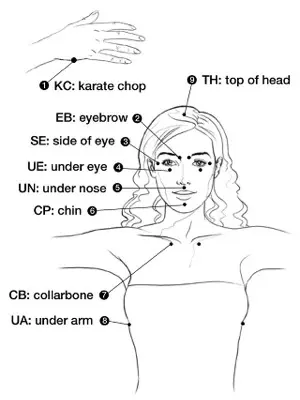
tapping pointsStandard EFT tapping typically incorporates nine acupoints on the face, hands, and body, according to EFT International:

  • Eyebrow (EB) Where the eyebrows start at the bridge of the nose
  • Side of the Eye (SE) On the bone along the outside of either eye
  • Under the Eye (UE) On the top of the cheekbone under either eye
  • Under the Nose (UN) The area beneath the nose and above the upper lip
  • Chin Point (Ch) The crease between your bottom lip and chin
  • Collarbone Point (CB) About two inches below and to the side of where your collar bones meet
  • Under the Arm (UA) On each side, about four inches beneath the armpits
  • Top of the Head (TOH) Directly on the crown of your head
  • Karate Chop (KC) The outer edge of the hand, on the opposite side from the thumb


Basic Script:

  • “Even though I have this [issue], I deeply and completely accept myself.”
  • “Even though I feel [emotion] about this [issue], I deeply and completely accept myself.”
  • “Even though I have this [issue], I choose to let it go and move forward in a positive direction.”
  • “Even though I feel [feeling], I deeply and completely love, accept, honor, trust and respect myself.

(Repeat these phrases as you tap on the tapping points until you feel the fear or tension decrease)

Script Sample – Fear of Failure:

  • “Even though I have this fear of failure, I deeply and completely accept myself and my fear.”
  • “Even though I feel anxious and nervous that I am going to mess things up and make a fool of myself and disappoint people, I deeply and completely accept myself and my feelings.”
  • “Even though I have this fear of failing and letting myself and others down, I choose to let it go and move forward with confidence and self-assurance.”
  • “I deeply and completely love, accept, honor, trust and respect myself.”

(Repeat these phrases as you tap on the tapping points until you feel the fear or tension decrease)

Script Sample – Health & Healing:

  • “Even though I have this [health issue], I deeply and completely accept myself and my body.”
  • “Even though I feel [emotion] about this [health issue], I deeply and completely accept myself and my feelings.”
  • “Even though I have this [health issue], I choose to let it go and focus on healing and feeling better.”
  • “I deeply and completely love, accept, honor, trust and respect myself.”

(Repeat these phrases as you tap on the tapping points until you feel the fear or tension decrease)

Remember, the key to using EFT effectively is to be specific and to focus on your specific issues and emotions. It’s also important to repeat the phrases with conviction and to tap on the designated points on your body as you say them. You may have to tap on the same issues over a period of time to see positive changes, but they will come.

Standard EFT Protocol

According to EFT International, the standard EFT protocol is used by the majority of EFT practitioners worldwide. It involves these steps:

  • Identify something that’s bothering you (e.g., a stressful situation).
  • Rate the intensity on a scale of 0 to 10 (10 is the worst).
  • Create a statement that describes your issue and includes a component of self-acceptance, like “Even though I’m stressed about work deadlines, I am doing my best and fully love and accept myself.”
  • Repeat a shortened version of that statement while you tap each point on your body several times, such as “Even though I’m stressed with work, I fully love and accept myself.”
  • Rate the intensity from 0 to 10 again and repeat the steps until the number decreases and you feel better.

Health

(For The Sake of Your Health & Longevity)
February 21, 2023 Functional Medicine Doctor & NY Times bestseller

By Mark Hyman, M.D. a practicing family physician, a 13-time New York Times best-selling author, and an internationally recognized leader, speaker, educator, and advocate in his field. He is the Director of the Cleveland Clinic Center for Functional Medicine.

When I was a medical student and resident, sleep was considered optional. Delivering 500 babies and working in the emergency department for overnight shifts fried my nervous system. I learned firsthand the dangers of sleep deprivation. Sleep, while it may seem superfluous, is essential to our health and longevity. The notion of “I’ll sleep when I’m dead” may cause you an early death. It affects every aspect of our health, including our metabolism, weight, mood, and cognitive function.

Over the last 100 years, the average night of sleep has declined by an hour or two. Seventy million Americans1 suffer from sleep problems. Lack of sleep not only impairs our ability to concentrate and causes trouble learning, decreased attention to detail, and increased risk of motor vehicle accidents; research suggests that regularly sleeping for less than seven hours a night2 has negative effects on the cardiovascular, endocrine, immune, and nervous systems.

Side effects of sleep deprivation can include obesity, diabetes, heart disease, high blood pressure, anxiety, depression, dementia, alcohol abuse, stroke, and increased risk of developing some types of cancer3

Sleep is essential for healing and repair and cellular cleanup and longevity. A newly discovered brain-cleaning system called the glymphatic system4 is essentially the lymph system of the brain and is necessary for cleaning up all the metabolic waste that accumulates every day.

Your muscles, organs, and brain need to repair each day. Your hormones and circadian rhythms must be in balance for health and longevity, and sleep is critical to maintaining that balance. If you want to understand the importance of sleep, you must read Matthew Walker’s book, Why We Sleep.

Here’s how to restore your natural sleep rhythm. It may take weeks or months, but using these tools in a coordinated way will eventually reset your biological rhythms:

  1. Practice the regular rhythms of sleep. Go to bed and wake up at the same time each day.
  2. Use your bed for sleep and romance only, not reading or television.
  3. Create total darkness and quiet. Consider using eyeshades and earplugs.
  4. Get grounded. Electromagnetic frequencies can impair sleep. I recommend turning off Wi-Fi and keeping all your electronic devices away from your bed. Create a charging station in a common area of your home and encourage all your family members to “check in” their devices before bed.
  5. Eliminate blue-light exposure for two to three hours before bed. Avoid computers, smartphones, tablets, and television two hours before bed. Avoiding blue-spectrum light after the sun goes down helps your brain reset for sleep and increases melatonin. Ideally, use blue-blocker glasses after sunset, a simple hack that pays sleep and health dividends.
  6. Avoid caffeine. It may help you stay awake during the day, but it interferes with your sleep.
  7. Avoid alcohol. It helps you get to sleep but causes interruptions in sleep and poor-quality sleep, something I have seen firsthand from data on my Oura Ring.
  8. Get regular exposure to daylight for at least 20 minutes daily. The light from the sun enters your eyes and triggers your brain to release specific chemicals and hormones like melatonin that are vital to healthy sleep, mood, and aging.
  9. Eat no later than three hours before bed. Eating a heavy meal prior to bed will lead to a bad night’s sleep.
  10. Take a hot Epsom salt and aromatherapy bath with lavender oil. Raising your body temperature before bed helps to induce sleep. A hot bath also relaxes your muscles and reduces physical and psychic tension.
  11. Use herbal therapies. Try 100 to 200 mg of passionflower or 320 to 480 mg of valerian (Valeriana officinalis) root extract standardized to 0.2% valerenic acid one hour before bed.
  12. Take 200 to 400 mg of magnesium citrate or glycinate before bed. Magnesium is a powerful relaxation mineral for the nervous system and muscles.
  13. Other supplements and herbs can be helpful in getting some shut-eye. Try calcium, L-theanine (an amino acid from green tea), GABA, 5-HTP, and magnolia.
  14. Find guided relaxation, yoga nidra, meditation, and guided imagery options online and listen to them before bed. Any of these may help you get to sleep.
  15. Try binaural beats sound meditation, which synchronizes brain waves for deep sleep. You can find videos on YouTube. They can be used before bed or in the middle of the night to help you fall back asleep.
  16. Try my free Sleep Master Class.

If after trying these strategies you still struggle with sleep, please see a functional medicine practitioner who can determine whether things like food sensitivities, thyroid problems, menopause, fibromyalgia, chronic fatigue syndrome, heavy metal toxicity, stress, or depression is interfering with your sleep. You can find one at the website of the Institute for Functional Medicine. Consider getting tested for sleep disorders such as sleep apnea. Getting good sleep is essential for your health and longevity.

Clinically reviewed by Dr. Chris Mosunic, PhD, RD, CDCES, MBA

Loving yourself sounds like it should come naturally, but most of us don’t find it easy. If you struggle to silence your inner critic or often find yourself overwhelmed with self-criticism, starting a self-love practice probably feels impossible. But it’s worth pursuing.

The thing is, self-love isn’t something that happens overnight. It’s a practice. And it takes time. Luckily, there are some simple steps and strategies you can follow to help you cultivate the qualities that will blossom into sustainable self-love.

What is self-love and why is it important?

Self-love is exactly how it sounds—it’s a love for self and having an interest in your own wellbeing and happiness. Loving yourself doesn’t mean being self-centered or selfish. It’s about forming a caring relationship with yourself, like getting to know a good friend.

Self-love is important because the relationship you have with yourself sets the tone for how you deal with every aspect of life: your bonds with others, the way you handle challenges, and how you celebrate joys. When you’re kind and understanding toward yourself, you’re better equipped to navigate life’s ups and downs.

But how do you start loving yourself? Where do you even begin? Self-love starts with understanding where you stand right now. Take a look at your current feelings toward your mental health, motivation, and overall wellbeing. Are you harsh with yourself when things don’t go as planned? Do you forget to celebrate your wins, especially the small ones? These little check-ins can pave the path to walking toward self-love.

What are the 7 steps to loving yourself?

Loving yourself isn’t a switch you turn on or off. It’s a practice that takes time, commitment and, well, practice, to cultivate. For many of us, the idea of loving ourselves feels out of reach. That’s why it’s often helpful to break the concept of self-love down into its distinctive elements — including self-trust, self-compassion, and self-awareness.

This can make it easier to start developing a self-love practice that feels achievable and manageable. So instead of viewing self-love as something you have to win at, try practicing these seven steps.

  1. Self-awareness: Understand your feelings, thoughts, and behaviors.
  2. Self-expression: Be true to who you are in all areas of life.
  3. Self-care: Take care of your body and mind.
  4. Self-trust: Believe in your ability to handle life’s ups and downs.
  5. Self-compassion: Be kind to yourself, especially when times are tough.
  6. Self-respect: Honor your worth by setting healthy boundaries.
  7. Self-acceptance: Embrace who you are, including the parts you don’t find perfect. Remember what we said about perfection?

7 ways to practice self-love, self-compassion, and self-care

Self-love can feel unfamiliar and challenging to some of us, particularly if we’ve got into a habit of being hard on ourselves. The steps above can help break down the idea of self-love into more manageable elements.

But what practical things can we do to cultivate practices like self-awareness and self-trust? We got you. For each of the self-love steps, we’re sharing tools, techniques and exercises you can use to help get you closer to loving yourself.

1. Build your self-awareness

Building self-awareness helps cultivate self-love by giving you further insight into what makes you who you are on an emotional level. Begin by tuning into your thoughts and feelings. What makes you feel happy, sad, or excited? Then, take it a step further. What makes you feel overwhelmed, overjoyed, or anxious? Knowing yourself is the first step to loving yourself.

  • Practice mindfulness: Try mindfulness practices to stay present and understand your thoughts and feelings better.
  • Educate yourself: Empower yourself through education by reading books, attending workshops, or engaging in discussions that promote self-awareness, self-compassion, and self-love.
  • Schedule regular self-check-ins: Reflect on your feelings, goals, and progress. Write them down, and revisit them often.
  • Tune into yourself through meditation: Spend some quiet time meditating to help declutter your mind and tap into your desires.
  • Let go of what no longer serves you: Let go of old habits or relationships that no longer contribute to your growth or happiness. We know this practice can be difficult, but removing what no longer brings you joy makes space for the good to come in.
2. Discover what self-expression looks like for you

Loving yourself also means giving yourself permission to express your thoughts and feelings both inwardly and outwardly. Express yourself honestly in your day-to-day life. Be true to who you are, whether you’re simply chatting with friends or making big decisions at work.

  • Engage in creative expression: Whether it’s drawing, writing, or any other form of creative expression, allowing your creativity to flow freely can become an act of self-love.
  • Discover new hobbies: Explore new activities that bring you joy and allow you to express yourself. Have you always wanted to try your hand at a group sport or acting? Now’s the time to try.
  • Journaling: Write down your thoughts, feelings, and experiences daily, and don’t hold back. Expressing yourself through writing can be cathartic and a helpful step in falling back in love with who you are.
  • Spend quality time with yourself: Enjoy your own company by doing things that make you happy. There’s a difference between doing something alone and feeling lonely. Embracing solo time and solo outings to the movies, dinner, or even a cooking class can be empowering, and, believe it or not, ridiculously fun!
3. Practice self-care

Caring for your body and mind plays a major role in cultivating self-love. Simple acts like mindful eating, exercise, and making time to relax can make a big difference in your overall wellbeing.

  • Make time for self-care: Dedicate time each day for yourself, even if it’s just a few minutes at the start of your day or before bed to breathe and ground yourself.
  • Take breaks when you need them: Remember to rest — even a micro-break can refresh and rejuvenate you. Want to amp up your rest break a notch? Take it outside. Being in nature can naturally calm and refresh your mind and body.
  • Practice relaxation: Use techniques like deep breathing or yoga to relax your body and focus on your breath.
  • Nourish your body: Fuel your body with nourishing food that makes you feel good.
  • Prioritize sleep: Ensure you get enough good quality sleep—it’s crucial for your wellbeing.
  • Connect with your body through movement: Move your body in a way that feels good for you. It could be dancing in your apartment to your favorite album, walking outside, or stretching from the comfort of your bed.
  • Ask for support when you need it: Reach out for help when you need it. Asking for support isa sign of strength, not weakness.
  • Set healthy habits to support your wellbeing: Create routines that promote your physical, emotional, and mental wellbeing. Perhaps it’s a walk in the park a few times a week, morning journaling, or cutting back on caffeine.
4. Embrace self-trust

It’s hard to love yourself if you don’t trust yourself. Embracing self-trust is about understanding that you have the ability to make the correct decisions for your life. Even when things don’t go as planned, believing that you can learn and grow from the experience is an important step in building self-trust.

  • Develop a growth mindset: View challenges as opportunities for growth, instead of viewing them as barriers, and trust that you’ll make it through. There’s no harm in trying and getting something wrong. Learn from it, and try again.
  • Set realistic expectations: Set achievable goals to build your sense of accomplishment and reinforce the belief you have in yourself to overcome.
  • Practice patience: Be patient with yourself as you uncover what self-love means to you. Trusting yourself takes time. Let it.
  • Monitor your negative self-talk: Pay attention to how you talk to yourself. Are you harsh or unforgiving? Do you speak about yourself poorly? Take note of how you speak to yourself and work to make it more positive and encouraging. Similarly to how we might lose trust in someone who speaks negatively, we can lose that same trust in ourselves.
  • Make a list of things you’re proud of: Reflect on your achievements and the things that make you proud. Look back on them when you need a dose of inspiration and remind yourself and believe that you can make yourself proud again and again.
5. Cultivate self-compassion

Be kind to yourself. Always. Especially when life gets tough. Celebrate your wins, learn from life’s mishaps, and don’t be too hard on yourself when it all doesn’t go as planned. Having compassion for self means you deeply care about your wellbeing. And feelings of deep care often mean love.

  • Practice positive affirmations: Craft and repeat positive phrases daily to help drive away those pesky negative thoughts.
  • Develop a self-forgiveness practice: Forgive yourself for past mistakes or perceived shortcomings. You’re only human. Remember that.
  • Try a loving-kindness meditation: Practice loving-kindness meditation to cultivate love and kindness toward yourself and others.
  • Put your hand over your heart and breathe deeply: This simple gesture can bring comfort and a sense of self-compassion.
6. Strengthen your self-respect

Respect yourself by setting boundaries to show yourself—and others—that your desires, wants, and needs matter. When we respect our boundaries and our wants, we’re showing ourselves love by prioritizing our needs.

Seek supportive communities: Surround yourself with supportive, loving, and understanding people who uplift you. The more you’re around people you respect and admire, the more you might begin to respect, admire, and love yourself.

  • Set boundaries: Give yourself permission to say no to things or people that drain your energy. Setting boundaries and sticking to them is an act of self-love, as it showcases to the world around you that you give yourself what you want and need.
  • Volunteer: Engage in volunteer work to connect with a sense of purpose and community. Volunteer to walk dogs at a local animal shelter or serve meals at a community kitchen. Giving back brings a deep sense of purpose and gratitude, and a way to give yourself love is to give love to others in need.
  • Celebrate your progress and success: Celebrate your wins, big or small, as all victories are steps toward growth. You’d cheer for a friend’s achievement, regardless of its size, wouldn’t you? Show yourself the same love and kindness and become your own cheerleader.
  • Honor your commitments to yourself: When you make a promise to yourself, keep it. Honoring your promises to yourself can help to build self-respect, which, as we’ve learned, enhances self-love by showing yourself that you’re a priority.
  • Cultivate self-worth: Grow your self-esteem by acknowledging your worth and capabilities. Worthiness is defined as something that is important and deserves recognition. Having self-worth drives positive action and belief toward self, which can develop self-love.
7. Embrace self-acceptance

Embrace yourself wholeheartedly. Every single inch. Even the parts you’d like to improve upon. You have nothing to gain by being hard on yourself, and everything to gain by being loving and accepting of yourself as you move along on your path in life. When you accept yourself, you’re declaring the love you have for self, regardless of what happens. Think of self-acceptance as a loving embrace.

  • Acknowledge and embrace your imperfections: Accept all parts of yourself, even what you don’t find to be perfect. Perfection is an illusion anyway, remember?
  • Learn to laugh with yourself: Embracing a light-hearted approach toward life and how you view yourself can help you meet those challenging moments with more ease and less friction.
  • Embrace where you are now: Appreciate the present moment. You’re here now. So, be here now and try to enjoy the journey.
  • Make space for your emotions: Allow yourself to feel your emotions. Emotions are natural, but ignoring them can become detrimental to your wellbeing.
  • Drop the comparison: Avoid comparing yourself to others. You’re unique and have your own journey.
  • Practice gratitude: Cultivate gratitude by acknowledging the qualities you appreciate about yourself and your life. This can shift your focus from what’s lacking to what’s abundant.

How to love yourself FAQs

How do I start to love myself?

Starting on the path of self-love begins with self-awareness. Notice your thoughts, feelings and actions. Begin to recognize what makes you smile or what makes you feel uneasy. Once you have a better understanding of yourself, you can start taking steps toward treating yourself with more kindness and respect. Remember, it’s a journey—there are no deadlines, and you don’t have to rush. And if you ever feel lost, you can always revisit the seven steps to gently reintroduce self-love practices.

Why do I struggle to love myself?

Struggling with self-love is a common human experience, so you’re not alone. Sometimes, past experiences, societal expectations, or harsh self-judgment can create blocks on the path to self-love. It’s important to remember that overcoming these hurdles takes time and practice, but with patience and persistence, it can get easier. Engaging in self-compassion practices and seeking support when needed are great steps when you encounter these struggles.

What are the signs of lack of self-love?

Lack of self-love can show up in different ways. It could be in the form of constant self-criticism, ignoring your own needs, or having difficulty with accepting compliments. It might also appear as feeling undeserving of positive experiences or neglecting self-care. The good news is that recognizing these signs is the first step toward change. Once you see them, you can start taking steps to build a more loving relationship with yourself.

What are self-love habits?

Self-love habits are small, daily actions that nurture a loving relationship with yourself. They could be as simple as speaking kindly to yourself, taking breaks when needed, or engaging in activities that make you happy. Other self-love habits include practicing gratitude, spending time in nature, eating nourishing food, and exercising in a way that feels good to your body. The goal is to create habits that make you feel loved, respected, and cared for.

12 Steps to Self-Care

  1. If it feels wrong, don’t do it
  2. Say “exactly” what you mean
  3. Don’t be a people pleaser
  4. Trust your instincts
  5. Never speak bad about yourself
  6. Never give up on your dreams
  7. Don’t be afraid to say “No”
  8. Don’t be afraid to say “Yes”
  9. Be kind to yourself
  10. Let go of what you can’t control
  11. Stay away from drama & negativity
  12. LOVE

The past is over: Forgiveness means giving up all hope of a better past.
“The weak can never forgive: Forgiveness is the attribute of the strong.” –Mahatma Gandhi

What forgiveness is:

    • Not what we do but the way we perceive people and situations.
    • Something that we offer others and something we accept for ourselves.
    • A DECISION to see beyond the limits of another’s personality. It is a choice to “see the light instead of the lampshade.” (Dr. Gerald Jampalsky).
  • AN ATTITUDE that implies that you are willing to accept responsibility for your perceptions, realizing that your perceptions are a choice and not an objective fact.
  • A PROCESS that requires shifting your perceptions again and again. It is rarely a one-time event because we habitually cloud our vision with judgments and perceptions of the past projected on to the present. Each time we shift to a deeper truth about others, and ourselves the ego weakens the monopoly on our perceptions.
  • A WAY OF LIFE that transforms us from victims to powerful and loving co-creators of our life. We can let go of the past and be fresh and out of fear in the present.

What forgiveness is not:

  • Not condoning negative, inappropriate behavior-yours or someone else’s.
  • Not pretending everything is fine when you feel it isn’t. Genuine forgiveness cannot be offered if anger and resentment are denied or ignored.
  • Not assuming an attitude of superiority or self-righteousness.
  • Not mean you will or must change your behavior.
  • Not require that you verbally communicate directly to the person you have forgiven.

“Though you may choose to behave differently, forgiveness requires only a shift in perception, another way of looking at the people and circumstances that we feel have caused us upset and pain.”

(This information primarily taken from, Robin Casarjian’s book, Forgiveness, A Bold Choice for a Peaceful Heart)

Self-Forgiveness

A Great Birth (excerpts taken from Forgiveness, A Bold Choice for a Peaceful Heart, by Robin Casarjian)

-“Forgiving yourself is probably the greatest challenge that you will ever meet. It is, in essence, the process of learning to love and accept yourself no matter what. ”

-“Love and self-forgiveness is essentially the same thing.”

-“The purpose of self-forgiveness is to shine light on the illusions, fears, and self-judgments that have held us captive in the role of the jailer”

-“Self-forgiveness is a great birth. It is inherent in those moments when the compassion, love, and glory of the greater Self is born within our direct experience and known beyond definition.”

-According to the theologian, Matthew Fox, “…the sin behind all sin is dualism. Separation. Subject/ object relationships.” “Take any sin….war, burglary, rape, every such action is treating another as an object outside oneself…. This is behind the sin.”

-“If we are separate from our Self, lost in fear, the instinctive survival mechanism will be to project this separation outward, trying to manipulate circumstances in an attempt to feel secure, in control, and powerful.” The irony is that we will actually feel the opposite.

-“Guilt can be healthy. …Healthy guilt posts boundaries…it guides our conscience. it is part of an internalized moral code…it is developed at around age 3.” We can get stuck in seeing our mistakes as that 3 year old!

-When you feel healthy guilt, but this guilt is indulged-if months or years later you are steeped in guilt for choices you made long ago this very same guilt becomes unhealthy. This is when the ego, in the form of the self-critic, acts like a robber who steals the present, has you tied to the past, and frightened about the future.”

– If you are dominated by guilt, it is impossible to feel compassion for yourself…it is by forgiving yourself that the bullying grip of the ego is released. It is by forgiving yourself that you can accept your mistakes as fearful reactions and confused attempts to get the power or love you felt you lacked…If we don’t forgive, the guilt will be played out in some way.”

-“The guilty self demands punishment for what it has done…it doles out its sentence in, depression, unhappiness, a chronic sense of unworthiness, or physical and mental illnesses.”

-“Self-forgiveness doesn’t imply condoning behaviors…or that you won’t feel remorse, but you need to move on from this place into a place of compassion. The truth is, you have made a mistake, but you essentially are not that act committed …yes, you are guilty of the behavior, but the essential Self is always guiltless and

  1. I have the right to ask for what I want.
  2. I have the right to say no to requests or demands I can’t meet.
  3. I have the right to express all of my feelings, positive or negative.
  4. I have the right to change my mind.
  5. I have the right to make mistakes and not have to be perfect.
  6. I have the right to follow my own values and standards.
  7. I have the right to say no to anything when I feel I am not ready, it is unsafe if it violates my values.
  8. I have the right to determine my own priorities.
  9. I have the right not to be responsible for others’ behavior, actions, feelings, or problems.
  10. I have the right to expect honesty from others.
  11. I have the right to be angry at someone I love.
  12. I have the right to be uniquely myself.
  13. I have the right to feel scared and say “I’m afraid.”
  14. I have the right to say “I don’t know.”
  15. I have the right not to give excuses or reasons for my behavior.
  16. I have the right to make decisions based on my feelings.
  17. I have the right to my own needs for personal space and time.
  18. I have the right to be playful and frivolous.
  19. I have the right to be healthier than those around me.
  20. I have the right to be in a nonabusive environment.
  21. I have the right to make friends and be comfortable around people.
  22. I have the right to change and grow.
  23. I have the right to have my needs and wants respected by others.
  24. I have the right to be treated with dignity and respect.
  25. I have the right to be happy.

Photocopy the above list and post it in a conspicuous place. By taking time to carefully read through the list every day, you will eventually learn to accept that you are entitled to each one of the rights enumerated.

tapping pointsStandard EFT tapping typically incorporates nine acupoints on the face, hands, and body, according to EFT International:

  • Eyebrow (EB) Where the eyebrows start at the bridge of the nose
  • Side of the Eye (SE) On the bone along the outside of either eye
  • Under the Eye (UE) On the top of the cheekbone under either eye
  • Under the Nose (UN) The area beneath the nose and above the upper lip
  • Chin Point (Ch) The crease between your bottom lip and chin
  • Collarbone Point (CB) About two inches below and to the side of where your collar bones meet
  • Under the Arm (UA) On each side, about four inches beneath the armpits
  • Top of the Head (TOH) Directly on the crown of your head
  • Karate Chop (KC) The outer edge of the hand, on the opposite side from the thumb


Basic Script:

  • “Even though I have this [issue], I deeply and completely accept myself.”
  • “Even though I feel [emotion] about this [issue], I deeply and completely accept myself.”
  • “Even though I have this [issue], I choose to let it go and move forward in a positive direction.”
  • “Even though I feel [feeling], I deeply and completely love, accept, honor, trust and respect myself.

(Repeat these phrases as you tap on the tapping points until you feel the fear or tension decrease)

Script Sample – Fear of Failure:

  • “Even though I have this fear of failure, I deeply and completely accept myself and my fear.”
  • “Even though I feel anxious and nervous that I am going to mess things up and make a fool of myself and disappoint people, I deeply and completely accept myself and my feelings.”
  • “Even though I have this fear of failing and letting myself and others down, I choose to let it go and move forward with confidence and self-assurance.”
  • “I deeply and completely love, accept, honor, trust and respect myself.”

(Repeat these phrases as you tap on the tapping points until you feel the fear or tension decrease)

Script Sample – Health & Healing:

  • “Even though I have this [health issue], I deeply and completely accept myself and my body.”
  • “Even though I feel [emotion] about this [health issue], I deeply and completely accept myself and my feelings.”
  • “Even though I have this [health issue], I choose to let it go and focus on healing and feeling better.”
  • “I deeply and completely love, accept, honor, trust and respect myself.”

(Repeat these phrases as you tap on the tapping points until you feel the fear or tension decrease)

Remember, the key to using EFT effectively is to be specific and to focus on your specific issues and emotions. It’s also important to repeat the phrases with conviction and to tap on the designated points on your body as you say them. You may have to tap on the same issues over a period of time to see positive changes, but they will come.

Standard EFT Protocol

According to EFT International, the standard EFT protocol is used by the majority of EFT practitioners worldwide. It involves these steps:

  • Identify something that’s bothering you (e.g., a stressful situation).
  • Rate the intensity on a scale of 0 to 10 (10 is the worst).
  • Create a statement that describes your issue and includes a component of self-acceptance, like “Even though I’m stressed about work deadlines, I am doing my best and fully love and accept myself.”
  • Repeat a shortened version of that statement while you tap each point on your body several times, such as “Even though I’m stressed with work, I fully love and accept myself.”
  • Rate the intensity from 0 to 10 again and repeat the steps until the number decreases and you feel better.
Your Content Goes Here

Healing

In this blog post I share how to connect to your spirit guides by following 10 steps. I believe we all have spirit guides, and when you cultivate a relationship with your guides you will receive clear, wise guidance to help you in every area of your life.

It’s important to understand that, because a lot of people say, “I don’t hear my guides, I don’t know if they’re there, I don’t get support when I need it.” That reflects disbelief and the active NOT allowing, which blocks the communication.

Your guides are always there. They are always supporting you. But they cannot come in unless you ask.

What Are Spirit Guides?

It’s said that we each have an angel on either side of us, and we also have guides — maybe a spirit who has been with us in lifetimes before, an ancestor who can support us, or someone we knew in our lifetime.

These are beings of the highest truth and compassion working on our behalf to guide our thoughts and energy back to love. They’re not physical and aren’t bound by the natural laws of this world. They’re spiritual beings.

We always have a relationship with these beings, but it’s up to us to decide whether we want to have a dialogue with them and let their presence be known.

These beings of light come in many forms, and they have different purposes, but their common goal is to help guide us back into alignment with the love of the Universe.

Why Connect with Your Spirit Guides?

Our spirit guides help guide us back into alignment with the love of the Universe. When you get stuck in a fear-based thought or pattern, you can turn to your guides to help lead you back to love. When you want to receive their guidance, all you have to do is be willing to surrender your fear and see with spiritual sight.

Our spirit guides are here to give us love and light; the simple act of asking for help opens us up to receiving divine guidance. Knowing that there is a presence always supporting you will give you unshakable faith and strength.

How We Experience Our Spirit Guides

Once you begin inviting in your spirit guides, there are different ways you might experience their presence.

Inner Knowing

You can experience a spirit guide as an inner knowing. You may feel or sense your guide’s presence, or “hear” a voice within, like a strong intuition or realization. Some people audibly hear (or see) their guides.

Sparks of Light

Sparks of light are another indicator of a spirit guide’s presence. Sometimes when I know my guides are with me, I see little sparks of light. It’s so cool to see that light and know there’s a presence with me at that moment!

Books Falling Off the Shelf

When books fall off the shelf, your spirit guides are the ones who are kicking them off for you! I can’t tell you how many people have written to me or spoken to me at an event and said they discovered my book because it literally fell off the shelf in front of them. You can experience this kind of guidance! It is available to you.

Free Writing After Meditation

Another way you can experience the presence of a spirit guide is through writing. You can call on your spirit guides through meditation, and following your meditation you can free-write and allow the voice of your guides to work through you.

Connecting to your spirit guides is about learning to rely on the voice of love. The reason these guides are here is to constantly bridge your thoughts from fear back to faith, forgiveness, love and light. They present you with creative solutions and beautiful opportunities.

Meditation

You can directly experience your spirit guides through meditation. Enter your information below to get a free meditation to help you connect. If you’re ready to open a connection to your spirit guides, follow these 10 steps.

• Get into the Habit of Asking

The first step to connecting with your spirit guides is to get into the habit of asking. When we forget that we can call on spirit for help, we start to rely on our strength. That’s when fear sets in. We often forget that we have guidance within us and around us. In the busyness of day-to-day life, it’s easy to forget this connection. Therefore, the first step is to get into the habit of asking your spirit guides for help, the more you ask, the more you receive – period

Make a List of What You Need Your Spirit Guides’ Help With

Make a list of the 5 to 10 biggest things you need help with. You can do this now, or you can come back to this exercise after aligning with your inner wisdom through prayer or meditation. Once you make this list, your next step is to offer up everything you need help with and invite your spirit guides to reveal solutions.

Only Call in Spirit Guides of the Highest Truth and Compassion

Remember always to call in the guides of the highest truth and compassion. You can do this through a simple prayer. Before connecting with your spirit guides, say silently or out loud:

Guides of the highest truth and compassion, I invite your guidance with the following issues…

You don’t want to invite funky guides to the party! Be very specific and clear about what kind of guidance you’re calling in so you don’t get any riff-raff coming through.

As with the human world, there are lots of different characters, and we don’t always want to invite every character over for dinner. The same goes for spiritual relationships. We want to open up our consciousness, space and energy only to the guides of the highest truth and compassion.

Don’t worry about this too much. You call the shots, so don’t fear those other beings. They can’t come in without your permission.

Remember That You Can Call on Your Spirit Guides Anytime

You don’t have to wait for a problem to crop up to contact your spirit guides. Every time I give a talk, the first thing I say backstage to myself is, “Thank you, guides of the highest truth and compassion, for speaking through me.”

Whenever I say this silent prayer to call on my guides, I know the words that I need will come through me. The simple act of asking is all that’s required for the guidance to show up.

• 2 Listen

The second step in connecting to your spirit guides is to listen. The way to do this is by meditating. When you meditate, you quiet your mind so that you can hear the wisdom of the guidance that’s within you and around you.

We must slow down our vibration to become aligned with the presence of these guides. When we attune our energy to the frequency of love and peace, we can more easily connect to the vibrational messaging of our spirit guides.

• 3 Write with Your Spirit Guides

Once you’ve meditated, your next step is to write with your spirit guides. Open your journal or just grab a few sheets of paper. At the top, write an invitation to them, such as:

  • “Thank you, guides of the highest truth and compassion, for revealing to me the solutions to these issues.”
  • “Thank you, guides of the highest truth and compassion, for revealing to me whatever you want me to know.”
  • “Dear guides of the highest truth and compassion, I welcome you to write through me now.”
  • “Thank you, guides of the highest truth and compassion, for writing through me.”

Then simply let your pen flow. Just riff onto the page, allowing whatever needs to come through. Ideas, stories, topics, inspired visions, things that you may not have thought of on your own, will begin to come forward. Don’t second-guess yourself or edit a word. Just write.

Your Spirit Guides May Speak Directly to You

You may find in this writing experience that your guides begin speaking to you directly. Instead of writing in the first person you may begin writing in the second person. When I am channeling my guides they often say, “Dear sister…”

In some cases, your handwriting might even change. You might feel a presence of energy moving through you. That means that there’s a presence that’s working through you to give you direction.

• 4 Ask for a Sign

Your spirit guides can play fun games with you! They like to show you that they’re present. So get playful with them and ask them for a sign.

Have you never asked for a sign before? Or have you asked but not known whether you received it? Learn how to ask for a sign and know when you’ve received clear guidance.

You’ll be blown away when you start to ask your guides to show you signs! It will rock your world.

• 5 Pay Attention to the Guidance You Receive

It’s one thing to ask for guidance. It’s another thing to witness it, to really take it in and relish in the presence that’s supporting you.

When you pay attention to the guidance you receive, you’re letting yourself be in the awe and wonder of all the love that is around you. It’s a big deal. This beautiful feeling is available when you truly let yourself witness the amazing support that is always with you.

The practice of paying attention to guidance isn’t about demanding.

You don’t go around all day asking, “Where’s my guidance? Where’s my guidance?” Instead, you simply allow yourself to be open to the wonder of that guidance.

Your guidance may show up in cool and unexpected ways, even in ways I haven’t mentioned here. Your guidance can show up as a song on the radio, a billboard on the freeway or somebody saying to you exactly what you needed to hear.

Our spirit guides often work through other people. They work through doctors, friends, children and even strangers. Spirit guides love to work through technology, too!

Throughout my spiritual practice, I’ve learned that there are trusted signs to look for when you are receiving guidance.

Here are 5 signs to look out for:
  1. You feel a sense of inner peace and calm. When you receive messages from your guides, you’ll often experience a deep sense of peace and calm. This can feel like a warm, comforting presence that surrounds you and helps remove any fear or doubt.
  2. You see repeat signs or symbols. Your guides may communicate with you through signs and symbols that have special meaning to you. If you keep seeing the same symbols or signs, this could be a message from your guides.
  3. You get sudden insights or inspiration. Your guides may also communicate with you through unexpected insights or inspiration. If you suddenly have an idea or a solution to a problem, it’s possible your guides are directing you.
  4. You feel guided to take specific actions. If you have a strong urge to take a specific action, even if it doesn’t make logical sense, this could be a message from your guides. Trust your intuition and follow the guidance you receive.
  5. You experience physical sensations. Some people report feeling physical sensations when they receive messages from their guides. This can include tingling in the body, a sense of warmth, or pressure in certain areas.

Everyone’s experience of receiving messages from their spirit guides is unique. What’s most important is to pay attention to the signs and messages that resonate with you and trust the guidance you receive.

  • 6 Stay in an Energy of Gratitude

As I mentioned in step 5, you want to thank your guides. Rather than being in a place of neediness, you want to be in a place of gratitude and appreciation for their guidance and love.

Shift the way you talk to your guides. If you find yourself thinking things like, “Guides, why haven’t you given me this yet?” or “Guides, I don’t believe in you. Why haven’t you shown up for me faster?” — you’re showing your distrust of them. You’re telling them you’re not really open to their guidance and that you want to be in control.

Your Gratitude Keeps Your Relationship Strong

Instead, you want to be thanking your guides, appreciating them and feeling deep love and gratitude for them.  When you receive any form of guidance, thank them. Just say silently, “Thank you, guides, for showing me this solution.” Or, “Thank you, guides, for this sign.” And when your guides give you a spiritual assignment, thank them for that as well!

Your gratitude keeps the relationship so strong and keeps those guides present with you all the time, because they know they’re welcome.

When you open your heart to offer your guides gratitude and appreciation, they boomerang that energy right back to you. It’s hard to describe what it feels like to be in this place of constant love and gratitude with your guides. It’s a tremendous and beautiful feeling. And it’s available to you.

  • 7 Release the Outcome and Trust in a Plan Better Than Your Own

Your guides have a plan that’s better than yours. They’re loving and wise, and they want to bring you to the right relationship, the right career, the doctor you need, the experience that will help you.

Sometimes we get in the way of that guidance. I’ve often avoided divine guidance by trying to control situations. I’ve obsessed over how things should go and tried to manipulate outcomes to get what I thought was best. Inevitably, this only pushed my guides away.

But… when we let go of our plans and trust in a plan that’s much greater than ours, we start to truly feel like we’re being led. When we surrender, we can feel our guides leading us to the next right action.

We must release outcomes in order to truly be in co-creation with our spirit guides.

  • 8 Be More Childlike

If you have young kids in your life, you may be aware that many children can still see their guides. They may even speak about them. Usually around the age of 7 the veil starts to close and we shut down to this guidance system.

To lift that veil and reconnect with your guides, be more childlike! Do things that bring you joy. Jump on a trampoline. Go for a run. Paint. Swim. Cook. Whenever I’m cooking, I feel the presence of my guides around me.

do the things that bring you joy, and guidance will show up fast

Remember, joy is the most powerful vibration we can embody!

  • 9 Ask Your Spirit Guides for Their Names if You Feel Called to Do So

You don’t have to do this step. But if you feel called to ask your guide’s name (or multiple guides’ names), ask them to reveal it to you. The first name that comes to mind will be the name of your guide. Even if it sounds strange, you can trust that what you hear is correct. Trusting your relationship with your guides is extremely important.

  • 10 Trust in Your Own Psychic Ability

Believe in yourself and in your capacity to call on this presence. Trust in your ability to connect to these guides and to feel that support. Know that you have an ever-present energy of love that is always within you and around you are supporting you and guiding you.

The more that you trust in your own psychic ability, the more you’ll be able to hear and the more you’ll allow this divine guidance to lead you to the highest good.

Allowing spirit guides into your life is a great gift.

Not only will they support you, but they’ll also help you help others. They’ll support you in being a light in the world. We need this presence of light to support us right now, in the chaos, drama and violence of these times. We need this presence to bring us back to love.

How to Ground Yourself After Connecting with Your Spirit Guides

When you tune into the spirit realm you may feel your energy shift. It’s important to take time to ground yourself after connecting with your spirit guides.

You want to always remember that you are having a human experience and you’re here on this planet in a body. To ground yourself back into your body you can do a few simple things:

  • Stomp your feet to ground yourself into the earth.
  • Sit on a rock to feel connected to the earth.
  • Take time to sit in stillness and drink a cup of tea or eat a snack. Do something that is consciously caring for yourself.
  • You can also zip up your energy. Imagine there’s a zipper at the bottom of your feet and zip yourself up all the way over your head and back down to your ankles.

Follow any one of these practices to get grounded after communicating with your spirit guides.

Connect with Your Spirit Guides Regularly

The more you talk to your spirit guides, the more you’ll rely on this ever-present guidance system. As you ask for and surrender to divine guidance, miracles will occur more and more often. (check out my blog post on angels and archangels.)

get more guidance

5 ways to awaken & harness your inner power

read article

read article

read article

5 Ways to Awaken & Harness Your Inner Power
You have the power to harness your inner power, raise your own energy and serve the world. And it’s easier than you might think. Your energy has far more power than you can even imagine. There is energy in the words you speak, in the words you write and in your physical presence. When we function from a fearful, low-level energetic state, our thoughts and energy can literally pollute the world. But when we function from a place of positive energy, the world around us becomes more positive.

Ready to awaken your inner power? By raising your energy, you can serve the world and make it a better place. Just follow these five steps from my book Miracles Now.

1. Be More Real

Your real inner power stems from your authentic truth. This exercise heightens your awareness of what it feels like to be in your truth versus what it feels like to be out of alignment. Take out your pen and paper and describe the differences between what it feels like to be in your truth versus what it feels like to be out of alignment with it. How do you act differently, talk differently, think and even breathe differently? Pay close attention to the differences in how you feel. Then, whenever you notice yourself out of alignment with your truth, use this affirmation: there is nothing more powerful than my authentic truth

2. Judge No More

The second step in harnessing and awakening your inner power is to heal the habit of judgment. Judgment weakens your power. I recently felt this firsthand when I noticed myself casually trash-talking. I wasn’t necessarily saying anything mean or untrue, but it was trash-talking, nonetheless. Afterward I felt awful. My energy was low, and I was weak. After witnessing how my words had weakened my power, I decided to change my ways. That moment I started counting how many days I’ve gone without judging. Now it’s been more days than I can count, and I feel more energized, more connected to others and more powerful! Each shift from judgment to unity is a miracle. The reason is simple: Judgment creates separation. A Course in Miracles says, “The ego cannot survive without judgment. The ego seeks to divide and separate. Spirit seeks to unify and heal.” Though judgment may be our default, unity is our truth. The moment we release judgment, unity is restored.

3. Remember Your Presence is Your Power

This ego eradicator meditation helps me bust through any stagnant energy and realign with my true source. I use this meditation right before I step onto the stage to give a talk, before an important phone call or any time when I want to bring my highest presence to the table. Try the ego eradicator today.

4. Access Your Power in the Service of Others

I once heard Marianne Williamson say in a lecture, “I’ll tell you how to find your power: Use your power for someone who has none.” She nailed it! There’s no greater way to awaken your inner power than to be in the service of someone who has none. If you’re feeling disempowered, immediately find a way to serve. Go to a homeless shelter, mentor a child — do anything that helps you discover your power and harness it to use in service of someone else. This radical action will instantly remind you of how powerful you really are and reinforce the essential idea that your power is best used to lift up others and serve the world.

5. Shine!

Most of us have been taught to turn down the light on our power. Playing small won’t work anymore. The world is in desperate need of more miracle-minded people waking up to their true power and purpose. It is your responsibility to shine bright. When you shine, you light up the world. Get into a daily practice of turning on your inner light. Use these tools throughout the day to be more real, stop judgment, meditate, and serve others.  As you live in your power on a moment-to-moment basis you will notice your life begin to flow. You will feel more connected to your purpose. You will live in the light.

get more guidance

Essentially, there are seven main chakras along the spine that correspond with major centers of the nervous system that interact with specific organs and glands. Each chakra has a specific color and function that can be focused on through clothing, foods, crystals, essential oils movement practices, and more. There are even specific affirmations that go with each chakra. Energy can flow freely when all the chakras are open and balanced, allowing mind and body to be more easily connected. However, as with all elements of the human condition, our chakras are rarely in perfect alignment and often require some attention.

Root Chakra – Located at the base of your spine, this chakra has everything to do with safety and security. Symptoms arising from this chakra can be related to various kinds of instability in childhood or in specific life experiences. This lack of grounding is often felt as abandonment-related as anxiety and can show up as fear-based decision making, often fueled by a scarcity mindset. Issues in the root chakra can lead to struggles in the rest of the chakras as they rely on the energy flowing up from this foundation. To heal the root chakra, channel anything red, earthy, and grounding. Pay extra attention when you see red in the world and let the sight of this color bring energy to this chakra. One of my favorite healing techniques here is to visualize a silky red ribbon winding its way around my body, comforting, and grounding me.

Sacral Chakra – This energetic center is located inside the pelvis and is home to the energy of emotions, creativity, and sexuality. Blockages here can relate to anything from depression to addiction and general emotional instability. You may be able to identify issues here through more physical presentations like tight hip muscles or sexual changes/dysfunction. I’ve noticed that problems residing in my sacral chakra are often the most difficult to talk about, which makes sense because they live in the world of nonverbal emotions.

As you work on healing your sacral chakra, follow your feelings more than your logical thoughts. Focus on the color orange and do activities that encourage creativity. One of my yoga teachers taught me that emotions live in the hips, and she was so right. If you really want to open this chakra, get into some long-held deep hip openers (half pigeon, butterfly legs, etc.). Bonus points if you warm up with some booty-moving interpretive dance. Either way, be ready for those tears to flow.

Solar Plexus – Just below your sternum at your naval point, this chakra is the seat of your personal power. If you’ve struggled with self-confidence, odds are you have some stuck energy here. Since this chakra lies very near to your stomach and intestines, blockages can also present as digestive issues (i.e. nervous butterflies in your stomach). The solar plexus is also where you might see a secondary manifestation of root or sacral chakra issues – if you experienced a period of instability, it likely impacted your ability to trust yourself and can result in anxiety. To heal the solar plexus, utilize lots of yellow and breathing exercises that warm you up, like the ujjayi pranayama used in most yoga classes. Challenge yourself in your workouts to hold longer than you believe you can. Practice some “I am ____” affirmations in the mirror. Intend to bring out your personal power in any way that you can.

Heart Chakra – This is perhaps the most intuitively understood chakra. It is located near your physical heart and revolves around your ability to feel an affinity to yourself and others – to love and be loved. This energetic center also functions as the bridge between the lower and more physically focused chakras and the upper more spiritual chakras. When we are disconnected here and struggle to have love for ourselves, mental illness can thrive. It becomes exceedingly difficult to do anything to improve your mental health when your heart chakra is suffering. Healing the heart chakra can also be an emotional process. Focus on green in your food, your clothing, and especially the world around you. Do heart/chest/shoulder openers in yoga. You can picture a warm, healing green light filling your heart space – it helps if you pair this visual with remembered sensations of feeling love.

Throat Chakra – This chakra is all about expression. Think of those moments where you speak up, or felt like you had something to say but couldn’t quite get it out. Perhaps you even felt a lump in your throat – that’s stuck energy in your throat chakra. Being able to ask for what you need is vital to healing any issue, but especially those around mental health. To heal this chakra, focus on a beautiful bright blue light in the center of your throat that enables your true voice to shine. Do some gentle neck rolls in the morning to get the energy flowing through. Throw some blueberries in your morning oats. Lean into the activities that allow you to truly express yourself and pay special attention to communicating authentically.

Third-Eye Chakra – Located between your eyebrows, this is the seat of your intuition. Here you can access your own inner knowing and look at yourself with the perspective of an observer. Trauma and mental illness often present as some kind of dissociation – this can happen when much of your energy is focused in this chakra and imagination has become a way to escape reality. This chakra is incredibly powerful, and has the ability to take us out of the present moment. Meditations that guide you into the center of your head are particularly healing for this chakra. Physically stimulating this area can feel lovely – run your thumbs from your third eye across your eyebrows and to your temple or roll it back and forth in child’s pose. Deep indigo is the go-to third-eye color, and I’ve also read that chocolate may be good for your third eye. I’m definitely not going to argue with that one.

Crown Chakra – This energetic center is just above the top of your head. It is the portal through which we access all the light and love of the greater universe. It can be difficult to directly relate this to anything in the physical world, but what can be easily said is that if there is any imbalance in any of the other chakras, the crown cannot possibly be in balance. Sometimes imbalances here show up as very rigid beliefs about religion, spirituality, and the way of the universe that make it difficult to grow. The best way to heal this chakra is to focus on the lower 6 chakras. You can focus on violet, but as this is not a physically oriented chakra it will not respond as much to physical things like colors. Pay special attention to the mystery in between things – the way the light travels from the sun to cast an enchanting golden glow on the leaves. Allow yourself to marvel at the nonphysical wonders that can only be experienced fully through the crown chakra.

Chakras can get incredibly complex (I got lost in so many rabbit holes writing this post), but they can also be beautifully simple. Even having an intention to send some good vibes to a certain chakra can be enough to make an impact. You have the freedom to get creative when working with chakras – make it as complex or as simple as you want. However, and this is my humble opinion, I think it’s the awareness and intention behind all of these actions that make them powerful. Notice how you feel when focusing on certain colors and pay attention to what your being may be trying to communicate to you. When you set out to mindfully show your body some love in a way it’s asking for, the results can be quite profound. Know that if a particular practice or belief in relation to a chakra feels right to you, even if you haven’t read about it here or in another article, it probably is and you should follow that intuition. Our beings are so intelligent all on their own. The practice of getting in tune with your chakras is just another way to help that knowing shine through.

Thanks to mindbodygreen and well+good for putting out some quality articles on chakras that helped me write this one, and especially to my meditation school, Psychic Horizons, for giving me the tools to use this knowledge in my own life.

1 Root chakra

The Root chakra is about being physically there and feeling at home in situations. If it is open, you feel grounded, stable and secure. You don’t unnecessarily distrust people. You feel present in the here and now and connected to your physical body. You feel you have sufficient territory.

If you tend to be fearful or nervous, your Root chakra is probably under-active. You’d easily feel unwelcome.

If this chakra is over-active, you may be very materialistic and be attached to things. You’re probably obsessed with being secure and resist change.

2 Sacral chakra

The Sacral chakra is about feeling and sexuality. When it is open, your feelings flow freely, and are expressed without you being over-emotional. You are open to intimacy and you can be passionate and lively. You are able to be creative and find your own unique creative expression.

If you tend to be stiff and unemotional or have a “poker face,” the Sacral chakra is under-active. You’re not very open to people or to finding your own creative voice.

If this chakra is over-active, you tend to be emotional all the time. You’ll feel emotionally attached to people and you can be very sexual.

3 Navel (Solar Plexus) chakra

The Navel chakra is about asserting yourself in a group. When it is open, you feel in control and you have sufficient self-esteem.

When the Navel chakra is under-active, you tend to be passive and indecisive. You may be timid and don’t get what you want. You worry about being accepted by others.

If this chakra is over-active, you are domineering and probably even aggressive.

4 Heart chakra

The Heart chakra is about love, kindness and affection. When it is open, you are compassionate and friendly, and you work at harmonious relationships.

When your Heart chakra is under-active, you are cold and distant.

If this chakra is over-active, you are suffocating people with your love and your love probably has quite selfish reasons.

5 Throat chakra

The Throat chakra is about self-expression and talking. When it is open, you have no problems expressing yourself, and you might be doing so through creative works.

When this chakra is under-active, you tend not to speak much, and you probably are introverted and shy. Not speaking the truth may block this chakra.

If this chakra is over-active, you tend to speak too much, usually to domineer and keep people at a distance. You’re a bad listener if this is the case.

6 Third Eye chakra

The Third Eye chakra is about insight and visualization. When it is open, you have a good intuition, and listen to your inner guidance.

If it is under-active, you’re not very good at thinking for yourself, and you may tend to rely on authorities. You may be rigid in your thinking, relying on beliefs too much. You might even get confused easily.

If this chakra is over-active, you may live in a world of fantasy too much. In excessive cases hallucinations are possible.

7 Crown chakra

The Crown chakra is about wisdom, spirituality, and being one with the world. When this chakra is open, you are unprejudiced and quite aware of the world and yourself.

If it is under-active, you’re not very aware of spirituality. You’re probably quite rigid in your thinking.

If this chakra is over-active, you are probably intellectualizing things too much. You may be addicted to spirituality and are probably ignoring your bodily needs.

A Beginner’s Guide to This Complementary Practice

The practice of energy healing has been around for centuries in cultures all over the world and has recently been picking up steam in the United States. Advocates for energy healing claim it comes with numerous health benefits, including reduced pain, improved depression and anxiety symptoms, and an overall sense of well-being.

But does credible research back these promises or is it a bunch of pseudoscience? Read on to learn more about energy healing, what the research says, and how you can get started if you’re interested in giving energy healing a try.

Definition of Energy Healing

Energy healing is a complementary approach based on the belief that our bodies have energy flowing through them, and that healing can come from helping to balance this flow, per the National Cancer Institute (NCI).

According to the National Center for Complementary and Integrative Health (NCCIH), energy healing therapy, also known as energy medicine, is a technique in which a practitioner channels healing energy through their hands (or other mediums, like acupuncture needles) to the client’s body to restore energy balance, which in turn brings about purported health benefits. Energy healing may or may not involve physical touch.

History of Energy Healing

Energy healing has roots in ancient forms of medicine, such as traditional Chinese medicine (TCM) and ayurveda. According to Johns Hopkins Medicine, the basic concept of TCM is that a vital energy force, known as “qi,” surges throughout the body. When there is an imbalance of qi, disease and illness may result.

Similarly, ayurveda, which originated in India more than 3,000 years ago, is a system of medicine based on the principle that disease is caused by an imbalance or stress in a person’s consciousness, per Johns Hopkins Medicine. The vital energy concept in ayurveda is called “prana” and has similarities to qi in TCM.

In both TCM and ayurveda, the goal is to support the body to achieve balance and realign your energy to find healing. This is done with a number of tools, such as massage therapy, acupuncture, and movement therapies like yoga and tai chi.

How Energy Healing Works

There’s no scientific consensus about how energy healing therapies work. Energy healing encompasses a variety of techniques believed to clear blockages in the energy field that contribute to imbalance in a person’s life, says Kristen Blythe, a reiki master teacher from the greater Boston area with training in more than a dozen energy healing modalities from around the world.

“Energy healing works on the principle that our physical body and life experiences are informed by the energies that exist in our energy field, and any imbalances or blocks in our energy field can contribute to emotional challenges, physical pain or illness, limiting life patterns, and other unwanted conditions in a person’s life,” she says.

How to Find an Energy Healing Practitioner

Most modalities of energy healing do not have an official regulating body, and there may be various schools and certifications available depending on the type. This can make it challenging to find a trusted practitioner, and you’ll need to do some research.

Blythe advises asking practitioners if they’ve taken certification courses in the methods they offer.

“It’s also important to consider the number of years of experience the practitioner has, as this can frequently be the best indicator of skill,” she notes. “As with any service, asking friends and acquaintances [or an integrative doctor] for a referral is often the safest bet for finding the right person to work with.”

Types of Energy Healing

There are dozens of energy healing modalities that come from traditions throughout the world, and some are more new-age creations. These include reiki, acupuncture, crystal healing, sound healing, qigong, reflexology, touch therapy, chakra balancing, polarity balancing, quantum energy healing, shamanic healing, emotional freedom techniques, and aura cleansing — though this list is not exhaustive, and the Institute of Noetic Sciences has resources on many more techniques.

While modern-day research is still emerging for many of these practices, the following types of energy healing have some scientific backing.

Reiki

Reiki is a form of energy healing in which a practitioner uses their hands and gentle touch to channel energy to the client’s body, per the Cleveland Clinic. The goal is to improve the flow and balance of energy to promote relaxation and healing.

Healing Touch and Therapeutic Touch

These are similar techniques dating from the 1970s and ’80s and are used in some hospital settings. They’re somewhat related to reiki, and have research to support their possible efficacy, but differ from reiki in some beliefs and techniques, like the use of touch or no touch, per the Earl E. Bakken Center for Spirituality & Healing articles on healing touch.

Qigong

Qigong is an ancient traditional Chinese practice involving breathing exercises and movement that aims to optimize energy within the body, mind, and spirit in order to maintain health and well-being, according to the NCCIH.

Reflexology

Reflexology is a type of energy healing in which pressure is applied to different parts of the feet to promote healing throughout the body, per the Cleveland Clinic. It’s rooted in traditional Chinese medicine and is believed to help balance the body’s energy.

A Special Note on Acupuncture

Acupuncture is a practice from traditional Chinese medicine in which very thin needles are inserted into the skin and then manipulated gently by the practitioner’s hands or by electrical stimulation, according to Johns Hopkins Medicine. When applied and moved to certain points on the body, it’s believed these needles restore energy flow and improve health.

Acupuncture is often included in energy healing topics, but it has significantly more research and evidence to support its use for pain and various other conditions, including clinical studies and experimental research on its mechanisms. This sets it slightly apart from other forms of energy healing in a biomedical context. You can learn more from the NCCIH about the broad research studies on acupuncture over the years.

Possible Benefits of Energy Healing

Scientific research on the health benefits of energy healing is lacking; the field needs more rigorous studies to determine efficacy. Some data suggests some forms of energy healing, including reiki, acupuncture, qigong, and reflexology may come with several health benefits, such as pain relief, improved depression and anxiety, and enhanced overall well-being.

Soussan Ayubcha, MD, an assistant professor of clinical family medicine and community health at the Perelman School of Medicine at the University of Pennsylvania in Philadelphia, notes these studies are too small to support general recommendations, and other studies show no clinical significance to date.

Here’s what some of the science says so far about the reported potential benefits.

Pain Relief

A major benefit of energy healing touted by practitioners is pain relief, and there is some scientific backing for that claim. A review of studies, published in Current Rheumatology Reports in November 2019, on qigong for musculoskeletal pain found that a consistent qigong practice soothed pain in varying degrees among adults with different forms of chronic pain, and with few side effects.

A meta-analysis in the May 2018 Complementary Therapies in Clinical Practice of four randomized controlled studies involving 212 participants found that, on average, those who received reiki therapy reported reduced pain scores compared with control groups.

Improved Depression and Anxiety Symptoms

Energy healing may improve mood and even help with symptoms of depression and anxiety. A 2017 review of 13 studies determined reiki was more effective than a placebo at reducing symptoms of depression and anxiety, as well as improving overall quality of life. A more recent review, published in November 2021, of 10 studies involving more than 1,200 adolescents determined that qigong was effective at reducing depression and anxiety among teens.

Danica Arizola, a licensed massage therapist and a reiki master teacher practitioner at Penn Medicine in Philadelphia, says in her experience, reiki may help with anxiousness because it can lead to a deeper level of inner listening and increase your inner knowing.

“Meaning, when you consistently take time to be quiet and still with yourself, over time a deeper level of intimacy is established within all aspects of the self — mentally, physically, emotionally, and spiritually,” she says. “When the body and mind are more at ease in a state of homeostasis, there is more opportunity and ability for healing.”

Enhanced Overall Well-Being

Those who practice energy healing techniques in a therapy session or on their own say one of the biggest benefits of the practice is that it induces a state of deep relaxation, which can enhance overall well-being. “In my observations, energy healing [generally] relaxes a person, bringing them to a state of breath and peace,” says Jennifer Izaguirre, a reiki master teacher and quantum energy healer.

One larger, uncontrolled online survey study published in the Journal of Alternative and Complementary Medicine in December 2019 involved 99 reiki practitioners and more than 1,400 reiki sessions. It found that even a single session led to significant improvements in overall well-being and other factors, like mood and pain.

May Help Cancer Patients

Energy healing is currently being studied in patients who receive cancer therapy to find out if it can improve quality of life, boost the immune system, or reduce side effects, according to the NCCIH. Some forms of energy healing have been shown to have some benefits to cancer patients.

One past study funded by the NCI found that women with advanced breast cancer who received reflexology treatments showed improvement in some symptoms, like shortness of breath, and overall physical functioning (like physical capacity and exercise capacity, based on self-reporting).

Arizola says cancer patients are often receptive to energy healing practices like reiki as a way to promote a sense of security.

“I often hear clients speak about feeling disconnected from parts of their bodies, whether it’s because of surgery, tumor sites, or scar tissue,” she says. “Reiki is noninvasive, and there is no pressure or muscle manipulation involved in its application. Because of this, cancer patients who may feel overwhelmed by clinical procedures, being poked and prodded, may feel more inclined to gentle touch and/or hovering over tender areas.”

Energy Healing Safety and Side Effects

Since energy healing is noninvasive, it is generally considered very safe. As with any type of therapy, it’s important to notify the practitioner of any mental health or medical conditions so that they are informed, Blythe advises. And it’s also crucial to talk to your primary care provider ahead of time about any therapies you intend to seek.

“Energy healing is never a substitute for medical care or psychotherapy, but can often be used in conjunction with allopathic [conventional] treatments,” she notes.

While each person’s experience will be unique, Blythe explains that common sensations clients may feel during energy healing include:

  • Tingling feeling throughout the body
  • Emotional release
  • Hot and cold sensations
  • Muscle twitches or tremors
  • Yawning or coughing
  • Dizziness
  • Seeing colors or images behind the eyes
  • Deep relaxation
  • Tiredness

Who Might Want to Try (and Avoid) Energy Healing

Energy healing is considered to be generally safe and may come with a number of health benefits, so if you’re curious about it, there should be no harm in giving it a try. That said, be sure to talk to your primary care provider or an integrative doctor before starting any new type of therapy.

“[Many people may] benefit from energy healing,” Izaguirre says. “There is no ailment, big or small, inside or out, that can’t somehow be touched by healing energy.”

Blythe notes that energy healing can be particularly helpful prior to and after surgery or other medical procedures, and for those who are experiencing pain, anxiety, or life changes.

“Reiki and other energy healing modalities are becoming a more common offering for hospital patients, and is certainly something [many] patients can benefit from,” she says.

As mentioned above, energy healing may cause some side effects some people might find unpleasant, such as dizziness, tiredness, or coughing.

“If any of these are experienced and cause concern, it’s important to reach out to the practitioner for support and advice on how to reduce or alleviate symptoms,” Blythe says.

Tips for Getting Started With Energy Healing

If you’re interested in giving energy healing a try, consider the following expert tips.

Do Your Research

Before you try energy healing, you’ll want to vet potential practitioners. Since most modalities don’t have a regulating body, try to look for practitioners with credentials like certifications, diplomas, or degrees from a school or course you find trustworthy, advises Izaguirre.

As the University of Minnesota’s Earl E. Bakken Center for Spirituality & Healing notes, a certificate is no guarantee that the practitioner has thorough training, so you’ll want to ask some questions, too, such as:

  • What’s your level of training?
  • When were you trained and how long were the classes?
  • How do you describe energy healing?
  • What’s your clinical experience?
  • Can you describe your sessions, including length of time and fee?
  • Do you practice energy healing every day?

Lily Allen-Duenas, a reiki master healer and crystal healer based in Des Moines, Iowa, advises looking for practitioners with credibility who also have a personality you’ll connect with.

“If you’re looking for an energy healer, give their website a good look over,” she says. “Read about their philosophy and methodology. Notice, of course, when and where they were certified, but you’re also looking for how you feel they’ll treat you.”

Try Different Forms

There are dozens of different types of energy healing, so you may want to give a couple a try if the first one doesn’t feel like a good fit. Read about the different modalities and see what appeals to you. Then look up qualified practitioners in your area to see what’s available or talk to an integrative doctor about possible recommendations nearby.

Be Open-Minded

Allen-Duenas notes that individuals who find the most benefit from energy healing are those who approach it with an open mind.

“If you are tense and closed-off, it is more difficult for energy to move through you,” she says.

What to Expect Before, During, and After an Energy Healing Therapy Session

What happens during an energy healing session will look different depending on what modality you’re engaging with. But generally, there are some things you can expect before, during, and after a treatment.

Before

Before your energy healing session begins, you’ll have a few minutes to chat with your practitioner to set expectations.

“A practitioner will typically ask the client what intentions they have for the session and if there are any particular concerns or imbalances they would like to release,” Blythe says. “There will often be an opportunity for the client to ask questions prior to the treatment itself, and the practitioner will provide an explanation of what the client can expect during a session.”

During

In many forms of energy healing your practitioner will ask you to lie on a massage table fully clothed at the start of the session. “Depending on the modality, the practitioner may touch certain areas of the body or hover their hands over the body without touch,” Blythe says.

It’s also common for your experience to change each time, she notes.

“The experience of the client is often different for each session and is directly influenced by their intention for the session,” Blythe says. “Some practitioners will talk during a session, others will remain silent, however it is always advisable to tell the practitioner if you are uncomfortable or have questions during a session.”

After

After an energy healing session is over, your practitioner will usually give you care instructions.

“These [often] include drinking plenty of water, resting, and eating something to help ground the body,” Blythe says. “The client may experience a continuation of energy clearing symptoms for an hour and up to several days after a session.”

What Does Energy Healing Cost?

The cost of energy healing can vary depending on type and practitioner.

“Charging for energy healing is strictly up to the practitioner, where they are located, overhead, and the time spent in a session,” Izaguirre says. “A professional practitioner may have spent hundreds or thousands of dollars on education, insurance, licenses, marketing, and other expenses.”

Blythe says most practitioners charge anywhere from $75 to $300 per hour, and other experts confirmed that range is normal.

Some practitioners may work with a sliding scale, and Izaguirre notes she has charged clients less than $75 depending on what the client is seeking and has even done some sessions for free.

Energy Healing Resources We Love

Favorite Organizations for Info on Energy Healing

National Center for Complementary and Integrative Health (NCCIH)

The NICCIH is the United States government’s leading agency for scientific research on complementary and integrative health approaches. Its mission is to use rigorous scientific investigation to determine the safety and efficacy of these methods of care. Check out the website for a breakdown of all terms related to complementary and integrative health, as well as more in-depth information on energy healing modalities like reiki, qigong, and acupuncture.

University of Minnesota Earl E. Bakken Center for Spirituality & Healing

The Earl E. Bakken Center for Spirituality & Healing aims to advance the health and well-being of individuals, organizations, and communities through integrative health and healing. On the center’s website, you’ll find essential info on many forms of energy healing, including healing touch, reflexology, reiki, shamanism, and qigong, as well as ayurvedic medicine. The center also produces a podcast, issues a biannual magazine, and has downloadable guides for students and nonstudents chock-full of tips and strategies to focus on well-being.

Institute of Noetic Sciences (IONS)

IONS is a nonprofit research institute started by a former NASA astronaut Edgar Mitchell, who has a website where you can dive deep into the diversity of these energy practices. IONS is supported by various researchers and groups and studies topics at the intersection of science and profound human experience. It’s a good resource for learning more about the different kinds of energy healing practices, how they may be used and applied, and to stay updated on current and new research.

The Takeaway

Energy healing is a complementary approach with roots in ancient and traditional medicine. While scientific research is ongoing to determine its benefits, evidence suggests that certain forms of energy healing practices may help with pain, depression, anxiety, and overall well-being.

While the practice is generally considered safe, do your research before choosing a practitioner, and talk to your healthcare provider before starting any new type of therapy.

Common Questions & Answers

What is the meaning of healing energy?

Energy healing is a technique rooted in the beliefs of ancient forms of medicine like ayurveda and traditional Chinese medicine (TCM) in which a practitioner channels healing energy to support the recipient’s body and mind. This is meant to restore energy balance and improve health.

What are the types of energy healing?

There are dozens of forms of energy healing, and this list is not exhaustive, but some include reiki, acupuncture, qigong, sound healing, reflexology, shamanic healing, crystal healing, touch therapy, chakra balancing, polarity balancing, and quantum energy healing.

Does reiki therapy really work?

There’s some scientific evidence to suggest reiki can help with a number of health concerns, including pain, depression, anxiety, stress, and overall mood. But these studies are small, and more robust research is needed to determine the true benefits.

Are there negative impacts to energy healing?

Energy healing is considered to be noninvasive and generally safe, but it may bring up some feelings and sensations that people find unpleasant or uncomfortable, including tingling feelings throughout the body, emotional release, hot and cold sensations, twitches or tremors of the muscles, coughing, and tiredness.

What happens during energy healing?

An energy healing session can look different depending on the type and practitioner. Generally, you lie on a massage table fully clothed and a practitioner may touch certain areas of your body (if you have given permission) or hover their hands over the body without touch. This is done to channel healing energy, called qi in TCM; other traditions and therapies have different names for this energy.

EDITORIAL SOURCES

Everyday Health follows strict sourcing guidelines to ensure the accuracy of its content, outlined in our editorial policy. We use only trustworthy sources, including peer-reviewed studies, board-certified medical experts, patients with lived experience, and information from top institutions.

5 Potential Health Benefits of Reflexology
Medically Reviewed byJustin Laube, MD
September 14, 2023

Reiki for Beginners FAQs: Everything You Need to Know to Get Started
Medically ReviewedbyJustin Laube, MD
July 19, 2023

5 Potential Health Benefits of Hypnotherapy
Medically ReviewedbyJustin Laube, MD
May 22, 2023

5 Things to Know When Selecting an Integrative Healthcare Provider
Medically ReviewedbyJustin Laube, MD
April 17, 2023

What Is Ayurveda? A Detailed Beginner’s Guide to Traditional Ayurvedic Medicine
Medically ReviewedbyJustin Laube, MD
March 2, 2023

5 Potential Health Benefits of Adding the Feldenkrais Method to Your Movement Routine
Medically ReviewedbyJustin Laube, MD
January 19, 2023

All About Reiki: How This Type of Energy Healing Works and Its Health Benefits
Medically ReviewedbyJustin Laube, MD
January 17, 2023

5 Potential Health Benefits of Massage Therapy
Medically ReviewedbyJustin Laube, MD|November 22, 2022

Massage Therapy: A Beginner’s Guide to This Type of Healing Bodywork
Medically ReviewedbyJustin Laube, MD|November 22, 2022

What Is EFT Tapping? A Detailed Scientific Guide on Emotional Freedom Technique
Medically ReviewedbyJustin Laube, MD|November 9, 2022

© 1996-2025 Everyday Health, Inc., a Ziff Davis company. All rights reserved. Everyday Health is among the federally registered trademarks of Everyday Health, Inc. and may not be used by third Parties

What are the next steps for understanding complete mindfulness and its comprehensive benefits? Five experts in the mindfulness field explain. 26 July 2024

Mindfulness Meditation:
Train Your Mind to Change Your Life

by Shauna Shapiro, PhD

The widespread applications of mindfulness are based on a few general principles whose simplicity and power have sparked what has been called the “mindful revolution.” Yet with all its popularity—or because of it—certain aspects of mindfulness have become obscured or misunderstood. The science-based “Intention, Attention, Attitude” (IAA) model helps us see mindfulness in its full, multidimensional nature.

Writing conceptually about mindfulness, a nonconceptual topic, is antithetical to its very nature. Mindfulness has to be experienced to be known. However, words offer us a beginning, a finger pointing to the moon.

“When we see clearly, we can respond effectively.”

At its core, mindfulness is a universal human capacity that transcends culture, language, and religion. Although the concept of mindfulness is most often associated with Buddhism, its phenomenological nature is embedded in most religious and spiritual traditions, as well as in Western philosophical and psychological schools of thought.

The word “mindfulness” in the ancient language of Pali—Sampajanna—means “clear comprehension.” Mindfulness helps us see clearly so we can make choices grounded in reality and respond to life with wisdom.

But seeing clearly is difficult because the lens through which we view the world is blurred by our parents, teachers, relationships, and society. All of these influence our perceptions on conscious and subconscious levels. We come to see ourselves in a certain way, others in a certain way, life in a certain way. Rather than engage the fluidity of the present moment, our views become frozen and static, like a photograph rather than a motion picture. Often, they operate unconsciously. Even at times when we are aware of our conditioned responses, we can’t seem to shift them, try as we might.

Mindfulness has the potential to free us from these conditioned responses. It helps us remove the filters, biases, and preconceived ideas that shape our perceptions and cloud our consciousness. Mindfulness helps us choreograph our life through awareness of the way things are, rather than through generationally and culturally conditioned responses. When we see clearly, we can respond effectively. 

To elucidate both the simplicity and complexity of mindfulness, we developed the IAA model of mindfulness, which is composed of three core elements: intention, attention, and attitude (Shapiro et al., 2006).

Intention

Looking at our intention puts us in touch with why we are paying attention. Intentions set the compass of our heart in the direction we want to head. They connect us with our personal vision, aspiration, and motivation.

Like the rudder on a sailboat, our intentions keep us on course, reminding us again and again of what is most important. This is why intention is so valuable. It is our personal blueprint, helping us stay connected with what we value most in life so it is not lost or betrayed. Our intentions wake us up from our automatic pilot and put us back in choice.

Intentions are not vague, mystical concepts. When you set an intention, it leads to a whole cascade of neurochemistry that helps support learning and neuroplasticity.

Here’s how it works: When you set an intention, it releases dopamine, the neuromodulator of motivation and drive. This then catalyzes the release of epinephrine, responsible for alertness and energy, and acetylcholine, responsible for focus and attention. By focusing on your intentions, you can set in motion a powerful neurochemical system of support, one that will optimize your ability to create lasting change in your life.

Attention

A second fundamental component of mindfulness is attention, learning to train and stabilize our focus in the present moment. In the context of mindfulness practice, paying attention involves observing the operations of one’s moment-to-moment internal and external experience.

This is what Edmund Husserl (1962) referred to as a “return to things themselves”—simply attending to experience itself, as it presents in the here and now. In this way, we learn to attend not only to the surrounding world, but also to the contents of our inner reactions to the world, moment by moment. Often our minds propel us into the future or suck us into the past. Mindfulness helps us return our attention to the present moment.

To see how training our attention works, try focusing your attention on the sensations in your right hand. Notice how you suddenly have sharp awareness of your right hand. A moment ago, your right hand was not in your awareness. Now it is. Shift your attention to your left hand. Notice how you now have awareness of your left hand. Learning how to intentionally move this “spotlight” of attention can alter the quality and direction of our lives.

This is not to say that sustained focus in the present moment is easy, particularly in the modern world. Scientists have measured the amount of data that enters the brain and found that an average person living today processes as much as seventy-four GB of information a day (like watching sixteen movies), through TV, computers, cell phones, tablets, billboards, and other sources of information.

Not surprisingly, this firehose level of input hinders our capacity to pay attention. As cognitive scientist Herbert Simon (1971) eloquently noted, “What information consumes is attention. A wealth of information means a poverty of attention.” As we train and stabilize our attention, we can become more effective at managing the daily data influx. We begin to see the present moment more clearly and make wiser choices in line with our intentions and goals.

Attitude

The third element of effective mindfulness is attitude—paying attention with an attitude of kindness and curiosity. This welcoming, open attitude enables the learning and information processing areas of the brain to function more effectively. The result? We can more objectively evaluate our situation so that we can respond effectively.

Our ability to bring an attitude of compassion and curiosity to all situations becomes especially crucial in difficult times. When we learn to meet pain (or fear, anger, loneliness, boredom, guilt, jealousy, shame, embarrassment, or disgust) with kindness and curiosity, we become our inner ally instead of our inner enemy.

Think about how you would treat a young child in pain. Would you say, “Stop that! What’s wrong with you?” Or would you embrace this suffering child and say, “Sweetheart, this is hard. Tell me about it. I care.”

This attitude of kindness and curiosity toward our inner and outer experience does not sugarcoat our emotions or try to suppress or change them. Instead, it allows us to experience them in a direct, yet safe and compassionate way. Paradoxically, by welcoming our experience without initially trying to change it, we actually change everything.

Neuroscience backs this up. Studies show that when we are judgmental and shaming, the learning centers of the brain shut down, shuttling resources to our survival instincts and robbing us of the resources we need to respond effectively. In contrast, an attitude of kindness strengthens the learning centers of the brain, bathing our system in dopamine, the neuromodulator responsible for learning and motivation (Rigoni et al., 2015). This expands our perspective and opens us to greater creativity and resourcefulness.

These attitudinal qualities do not add anything to the experience itself, but rather infuse the container of attention with acceptance, openness, caring, and curiosity. For example, if impatience arises while practicing mindfulness, the impatience is noted with acceptance and kindness. However, attitudes are not meant to substitute for the impatience or to make the impatience disappear—they are simply the container. These attitudes are not an attempt to make things be a certain way. Rather, they are an attempt to relate to whatever is in a certain way.

Mindfulness is the awareness that arises through the synergy of all three of these elements—intention, attention, and attitude. These elements become the “tongue” of mindfulness that fully tastes each moment. Through being present with experience in this way, insight arises. We see into the nature of things and realize fundamental truths: that everything is impermanent; that suffering is caused by confusion, leading to fear, greed, and hatred; and that everything is connected, nothing is separate. These insights begin to inform how we perceive and live our lives.

At the deepest level, mindfulness is about freedom—freedom from reflexive patterns, freedom from reactivity, and, ultimately, freedom from suffering. We see that what we experience as our separate sense of self is simply awareness happening. This is the essence of the nondual nature of mindfulness—of no separation between ourselves, others, and all things—exemplified by this beautiful teaching by Ram Dass:

When I forget who I am, I serve you.
Through serving, I remember who I am
And know I am you.

Insight: The Power of Seeing Reality Clearly

by Gullu Singh

Mainstream mindfulness practice typically focuses on techniques to calm, relax, and focus the mind. This can be done by anchoring the attention on the breath or another focal point and letting go of everything else. These practices demonstrably improve well-being and reduce stress.

A good mindfulness teacher will also encourage meditators to use their practice to cultivate positive qualities such as confidence, patience, determination, and kindness. We can refer to the development of relaxation, calmness, and positive qualities as “cultivation practice.”

There is another important side of meditative practice that is underemphasized in mainstream mindfulness. This is the development of insight or wisdom. Using the power of clear observation we develop through mindfulness, we can gain a deeper understanding into the nature of reality and our own being. While cultivation practice does help us feel better, relax, and be better people, it is this insight practice that ultimately liberates us from mental reactivity and suffering.

“Through the power of self-awareness, there is no limit to what we can discover that leads to greater wisdom.”

Insight practice invites us to continually examine what is happening in our mind, facing discomfort to understand our experience and its causes. This demands courage, confidence, and persistence.

As a beginning meditator, I learned to silently label my thoughts “thinking,” “planning,” or “remembering” when they arose. One day, I suddenly realized that all of my thoughts involved planning. Of course, I knew myself to be a planner, but this was a sudden revelation of the magnitude of this force in my life. Further observation showed this way of thinking was intertwined with a constellation of tension, restlessness, and anxiety in my body.

This insight has made me more aware of planning thoughts and their associated physical sensations, helping me to avoid being compulsively driven by those thoughts out of habit. The insight into this pattern reduced its power.

Through the power of self-awareness, there is no limit to what we can discover that leads to greater wisdom. But it is helpful to have some pointers about areas that are ripe for exploration.

One helpful thing to notice is that when an experience is unpleasant or painful we often tense up or have strong aversion, which causes a tightening in the mind and makes an already unpleasant experience even worse.

Conversely, when an experience is pleasant, we might become attached to it, crave it, or worry about losing it, all of which also cause mental constriction. Of course, we might know this intellectually, but paying close attention to this process, which is happening in every moment, can show us how insidious it is in undermining our sense of well-being. Realizing and truly feeling the pain of this process helps us loosen our grip on our preferences, which leads to less reactivity and greater well-being.

Another good place to investigate, which is revealed with even the most cursory inward examination, is how experience is a constantly shifting cascade of thoughts, emotions, and sensations. No two moments are the same, and no experience lasts.

Observation of change can be unsettling initially. Typically, we struggle against this change and thereby create more discontent. Cultivating more stability in the mind acts as a counterbalance to change that allows us to embrace it more fully. This insight is complete when we truly grasp the truth of impermanence and the utter futility of trying to cling to or resist anything in this ceaseless flow.

Society’s usual recipe for happiness is to maximize all that is pleasant in our lives while pushing aside, denying, or suppressing the unpleasant. Unfortunately, it is hard to get conditions so perfect that we don’t suffer, and when we occasionally succeed, the conditions do not last.

The insight here is that experiences have no lasting satisfaction due to their fleeting nature and because the mind’s desires can never be fully sated. Seeing the futility of this acquisitional paradigm can be destabilizing or even depressing, so we must continue to cultivate well-being to keep the mind in balance. But in the end, the insight that things are not ultimately satisfying frees us from this exhausting project of constant rearranging of our lives to try to get the perfect conditions. It invites us to find contentment in the moment—in the process of living rather than the results we seek.

The most elusive and yet most profound insight comes from observing how our usual sense of self creates suffering and struggle. We cling to the self as if it were a fixed, solid thing that must be constantly tended, defended, and satisfied. We can see this in the way we constantly compare ourselves to others, in our desperate need to be seen in a particular way (smart, funny, athletic, etc.), and the fierce defense we mount when our identity feels threatened, like needing to be “right” in arguments.

We all know that this painful self-consciousness and self-preoccupation often fades in wordless moments of beauty in nature, during intimate connection with another being, or when we are fully absorbed in a wholesome activity. These experiences offer us a glimpse into a deeper truth: the sense of self is also constantly in flux. It is a process, not a solid thing, and there is no ultimate satisfaction to be found here.

The renowned meditation teacher Gil Fronsdal suggests that cultivation practice and insight practice must be in balance. It can be discouraging when insight is overemphasized, because many of the insights we have point to the reasons why we suffer. Conversely, if cultivation is overemphasized, then our practice can become an endless self-improvement project, and that doesn’t bring a lot of happiness either.

Cultivation practice and insight practice are mutually supportive. Finding the balance between them is an art, and practitioners who do so will be well rewarded. By combining the cultivation of calm and inner strengths with seeing how the mind constructs suffering, we embark on a more complete and worthwhile path of practice—and life.

Gullu Singh is an authorized teacher of Mindfulness-Based Stress Reduction. A corporate attorney for thirty years, he offers mindfulness training in law firms and other businesses and mindfulness mentoring to individual practitioners.

Ethics: Living Our Values

by Rhonda V. Magee

The practice of discerning right from wrong and applying what we learn in everyday life, what we might call ethics-in-action, is seen by many an inherent aspect of mindfulness. Perhaps for this reason, many assume that mindfulness provides enough of an orientation toward ethics that we don’t need to spend much energy focusing on it. We teach interconnection and compassion, many seem to say, and ethical behavior “off the cushion” flows naturally from that.

Maybe. But I believe there is value in emphasizing the ethical underpinnings of mindfulness. Doing so might better enable the kinds of sometimes risky actions—speaking truth to power; courageous storytelling; living and working across lines of difference; organizing against overconsumption, violence, and ignorance; and more—that are often necessary to grow and sustain capacity for living more compassionately together.

So why, even in the face of the growth of conflict and aggression right alongside the growth of mindfulness in our world, do we so often hesitate to center on ethics?

It could be due, in part, to uncertainty about what ethics means. My understanding of it was no doubt shaped in the lap of my mother, Ruth, whose views were no doubt shaped in roughly the same place of her mother, Nan, and by the teachings of the prophetic Christianity they practiced—teachings that made it hard to make a permanent enemy of any of God’s children.

Given this upbringing, I tend to expect mindful­ness-based meditation and communities to assist us in experiencing a planetwide sense of our responsibility toward one another. So I was heartened when I learned that, in the teachings of the Buddhist lineages from which mindfulness was born, practitioners are invited to practice with a core set of moral commitments or “precepts,” as a foundational part of the journey. Often presented as vows, they implore us to practice avoiding hurting others, lying, stealing, sexual misconduct, and intoxication.

In the cultural West, the legacy of the countercultural revolution in the mid-twentieth century (promoting individual freedom for everyone all of the time) set us up to be wary of other people’s morality. To this day, we are often allergic to following someone else’s rules. So perhaps it is not so surprising after all that, even in a time of unprecedented interest in mindfulness as a way of being in the world, the kind of mindfulness we see often appears stripped from its essential ethical foundation.

“Becoming aware of the consequences of our choices — and living differently as a result — is the true power of mindfulness in the world today.”

I do not see the precepts as a call to adhere to rules, to gain approval as a “good meditator.” I see their value in their practical effect. They remind us to pay close attention to why and how we do these things, and to just how they affect others. They help us incline ourselves toward more caring behavior in response. Practicing the precepts, we experience the ethical principle of not causing harm as a touchstone in daily life. We come to know it not as an “add-on,” but as the very foundation of mindfulness.

I believe that we need to put the ethical principle back. Mindfulness can remind us of what we learned as children about how to tell the difference between right and wrong. This will look a bit different for each of us. For me, for example, the “ethics in a nutshell” coming out of my mindfulness practice is infused with what feels to me like soulfulness. When contemplating whether or not to take any given action, I ask, will it cause suffering in myself? In the world? And more specifically, will it cause more harm among those who’ve already suffered more than their share? Or will it help diminish it?

This deceptively simple inquiry practice won’t solve all of our problems. But it will help keep us mindful of the fact that we live in a world with others, a fact replete with moral implications.

Here is the next rub. Even if we are willing to practice for ethical living, we come across the hard truth that doing so is not easy. And what about figuring out what truly compassionate steps to take in response? Often, this is more difficult still.

For these reasons it is clear that in addition to exploring what ethics is, we need support in discerning how to make good on applying ethical insight in our everyday lives.

Does the way we practice and teach mindfulness help us do that? Can it help us do it more, and better?

I think so. To deepen its impact, though, we need more than the teachings and practices. This is where communities of practice come in.

Communities of practice—places wherein we can consistently work with real human beings to meet conflict and difference as it arises in and around us—give us the organic structures of experience and support that we need to live ethically. They require that we soften our tendencies toward overinvesting in ourselves to the detriment of others. And in these times, when we can see all around us the temptations of tribalism and self-focusing as means of responding to fear and dread, these and other teachings, practices, and experiences that disrupt the temptations of self-ing could not be more timely or important.

To support us in softening the temptations of othering, we need a mindfulness capable of looking at the barriers to caring across lines of real and perceived difference. Cultivating such mindfulness benefits from actually being in diverse communities. Even the Buddha’s applications of mindfulness extended to awareness of the external injuries caused to socially different others, for example, by the system of caste. Even then, the ethics of mindfulness pointed practitioners toward addressing the variety of everyday injuries to dignity and concern for others that our cultures and subcultures make seem natural and necessary.

Thus, Buddhist history suggests that living with social and cultural difference helps attune us to the ways that our cultures make “normal” casual, everyday, and systemic harm to vulnerable “others.” It suggests that mindfulness, practiced rightly and alongside others, prepares and inspires us to address it. And looking back, I can see how my efforts to live ethically in the world have been strengthened by both working and living in multicultural communities. To this day, I learn about ethics from the inside out while moving through the negotiations, temporary pauses, intermittent battles, reframing of problems as possibilities—and more—that decades of living in differently diverse communities demands.

Over the years of actually struggling with others, I’ve meditated on how being with difference assists us in minimizing harm as we struggle-while-changing, together. Because when it comes to mindfully discerning what to do about conflicts in the broader world, cultivating the ability to sit with the perspectives of people whose experiences differ from our own is essential.

Taking inspiration from those who have gone before, I read about spiritual justice activists whose lives suggest that they practiced like this. And it gives me reason for hope. Studying the very embodiments of ethics, the exemplars of the good, the unselfish, the needlessly kind across a range of religious traditions—people like the Buddha, Jesus, Martin Luther King Jr., Grace Lee Boggs, Thich Nhat Hahn—one sees that they, too, moved between worlds, and among those at the margins of their societies. They were as often as not working with those different from their original “tribes.” They navigated worlds of different perspectives and values. And the actions they took were tempered by—elevated by—a capacity to see themselves in the eyes of people who did not look like them, and whose lives had taught them different views on questions of right and wrong. This is the ethics of mindfulness in action.

A commitment to such ethics has never been more important than in the multicultural societies in which so many of us live in the modern era. It helps us combat the othering in our midst, to see through the dehumanizing messages with which we are constantly bombarded. They help us live well, side by side with people who are different from ourselves. Cultivating this aspect of mindfulness, then, is critical in these times, when doing the opposite has diminished the communing together that leads to its natural arising, and led to increased tribalism and other pathways toward its very opposite.

Our mindfulness can support us in considering where, when, and how to act for justice, and in creating new institutions, policies, and practices that reduce suffering. It can support us in doing all that will be necessary to keep mindfulness from morphing into a subtle tool of oppression.

And how, more precisely, can this be so? Well, rather than offer a specific prescription, I suggest that our whole practice, in these times, must be energized by, grounded in, questions like this. The answers we need to explore, the ones that reflect the values and insights of mindfulness, will arise when we bring insight to our socially embedded lives—to the particular histories, lingering inequities, power differences, thinly veiled melancholy, deferences, and resentments—all while keeping our hearts open. These answers will be flexibly attuned to the fact that the changing situations in which we find ourselves matter—and, that they are not static. Everything is always already changing, in ways we variously experience as good, bad, or neutral. Practicing ethics in diverse communities helps us see, in these changes, that the reality of multiple and conflicting experiences will not break us. Instead, from such experiences, novel possibilities emerge.

The teachings underlying mindfulness reveal that becoming aware of the not-so-obvious but nonetheless harmful consequences of our everyday choices—and practicing, courageously, living differently together as a result—is the true power of mindfulness in the world today. And because doing so is not always easy, ethical practices invite working toward repairing the harms we—even partly, even unintentionally—cause. When, as a result, we disrupt those everyday habits and conventions—when we choose caring for others, consuming less, telling more of the truth, respecting others’ things, respecting others’ bodies and sexual integrity, and sobriety—we feel the changes in our hearts, minds, and bodies, in the very seat of consciousness itself.

We know from our experiences that expanding our presence, experiencing more of these sense impressions, feelings, and being “called out” or “in” will not always be easy on us. It will not always feel like joy, or spa-like bliss. But mindfulness is about deepening wisdom through awareness of sensations, feelings, and thoughts and developing emotional intelligence. We practice becoming friendly with the discomfort that flows with learning and growing. However challenging, we learn that we must move at careful speeds through all such discomfort, and in thoughtful directions. Our patience ripens as we pause, our agility strengthens as we adjust, our courage arises as we take what life-affirming actions we can. And our freedom expands as we let go.

Our hesitancy to center on ethics as part of the very practice of mindfulness does more than limit our experience of freedom. It gives the often very subtle and most socially acceptable forms of greed, hatred, and delusion shadowy room within which to roam. Practicing with the ethical rules in interactions with others helps soften the parts of ourselves that can too easily privilege our own comfort over that of others, especially in the face of real change. And practicing ethical engagement in diverse communities of so-called Others gives us real-world experiences that move and change us, replacing the shadow in and around us with the light of awareness.

Being mindful of not only obvious, but also subtle forms of greed, hatred, and ignorance in our lives and society nurtures the ethical roots of engaged mindfulness. Exposing ourselves regularly to the dimensions of harm that move through conventional social habits and processes of identification can help us when we meet the “stranger”—whether within ourselves and families, in our communities, in the café down the block, or in the newsreel or social media post from the other side of the world. And it is being in regular and well-supported contact with the other that can help show us just how to meet the stranger in the spirit of planetary loving-kindness that is, I believe, the ultimate gift of mindfulness in these times.

Indeed, this is why when I stand for a socially attuned and ethical form of mindfulness, I stand for seeing more clearly what supports its organic arising. I stand for what binds us together as one quilt, strengthened by the warp of conflict and weft of new cultures, unexpected reversals, and beginning again.

The quiet ethical revolution I call for here is, then, so much more than a renewed call to attend to the old rules. It’s a way of being and doing, capable of stitching together the patches of our inherent already-belonging. This might better be called “ethics-ing.” It’s a way of seeing our mindfulness practices as the means of cultivating moral imagination. It can help us explore what the pop icon Beyoncé Knowles-Carter encouraged millions to practice in a recently released song—standing together and standing for something, even when we can barely stand one another.

I end this essay with an explicit call to ethics-ing-in-action. I pray that the light of awareness illuminates what caring-across-difference looks like, in the very communities where we live and breathe. Because change itself is calling for just such a renewed line of sight. And when we find ourselves at untraveled crossroads, may a reconceived mindfulness—enriched by the soulful, creative, and compassionate heart-qualities that support making change ethically—increasingly ground, uplift, renew our views, and dance with us there.

Rhonda V. Magee is the author of The Inner Work of Racial Justice: Healing Ourselves and Transforming Our Communities Through Mindfulness. She’s the founding director of the Center for Contemplative Law and Ethics at the University of San Francisco.

Love and Compassion

by Tara Brach, PhD

If you were at the end of your life looking back, what would matter most to you? For me, it would be the moments of loving, of tender connection with others and this living world. We love so much—life, truth, beauty, awakening, love itself. This is what infuses our lives with meaning. Whether we call it compassion, kindness, or just love, it is an essential part of the path to a happy, fulfilling life and a better world.

Yet, according to a palliative care worker I know who has sat with thousands of dying people, people’s most common end-of-life regret is not having lived a life that was true to themselves, true to their own heart. Rather than opening to the joy of loving presence, we humans tend to be self-absorbed and anxious. There are good reasons for this. Because of our basic survival instinct, we have an innate bias toward the negative, focusing on potential threats and problems. This can lead to being defensive, judgmental, and aggressive—toward our inner life and others.

So although love is a natural, hardwired capacity in us, living with an open heart requires intentional cultivation. For many people, learning to hold our own being with compassion is the first step.

“Mindfulness and compassion are like two wings of a bird — we need both to fly, to be free.”

I was twenty when I became aware of what I now call “the trance of unworthiness.” I was fixated on all that seemed wrong with me—my personality, insecurities, weight, behavior in relationships, everything. It was impossible to love myself in the face of this perceived badness until I discovered the key to self-compassion: acknowledging that I was hurting. I needed to be touched by the reality that I was suffering.

Here’s an analogy I find helpful in developing compassion toward ourselves and toward others. Imagine you are walking in the woods and see a small dog by a tree. As you bend down to pet it, the dog lunges at you with bared teeth. How do you react? Would you be angry? Fearful?

Now, what would happen if you noticed that one of the dog’s legs was caught in a trap, and they were reacting out of vulnerability and pain. Your relationship with the dog would shift dramatically, wouldn’t it?

The same is true of us. Whenever we behave in unhealthy or hurtful ways, we are suffering. It’s as if our leg is caught in that trap. Seeing the hurt behind the behavior softens our heart. As we bring a mindful awareness to our vulnerability and suffering, we naturally cultivate a compassionate heart toward ourselves.

The challenge is that we’re conditioned to avoid our vulnerability—no one wants to experience raw, unpleasant emotions! So instead of feeling our feelings, we can spend days, even decades, spinning in judgment and blame, anxiety and/or depression.

I experienced this kind of stuck-ness during an extended period of an unidentified illness, which, thankfully, has since resolved. Yet, as I spiraled into an increasingly limited life, I was depressed and filled with harsh self-judgment. Here I was, a spiritual teacher being a bad sick person—small-minded and self-centered, irritable and impatient with others.

One morning while meditating, I said it out loud: I don’t like myself. I don’t like being me. After decades of teaching radical acceptance, that got my attention! I asked myself a powerful question: “What am I unwilling to feel?” Along with the deep pain of shame, I saw that my heart felt squeezed by intense fear—fear of uncertainty, fear of losing all I loved about life. My leg was caught in a trap.

I allowed myself to lean in and open mindfully to the clutch of fear. As I did, the fear gradually morphed into grieving the loss of cherished parts of my life: hiking, swimming, the pleasure of connecting with others, and so much more that brought me joy. Finally, I could weep. It felt as though my spiritual heart was holding my human heart, attending to the pain with profound tenderness and compassion. Inhabiting this vast heart space let me know I could love myself and this living, dying world, no matter what. It deepened my trust that loving presence is more the truth of who I am than any story about a sick, deficient self.

Mindfulness and compassion are often referred to as two wings of a bird because we need both to fly, to be free. For me to awaken compassion, I needed to bring a clear and direct mindful attention to the fear I was feeling, to how my leg was in a trap. And for that attention to be full and intimate, it needed to be accepting. Mindfulness needs to have the gentleness and warmth activated by the wing of compassion. These wings are entirely interdependent: there is no clear seeing without a nonjudging openness, and there is no felt tenderness, no responsiveness, without direct embodied contact with what is arising.

Compassion is a game changer, in both our own lives and our relationships with others, because this tender responsiveness softens the armoring around our heart. It dissolves our feelings of separateness and reveals a larger field of loving awareness—a oneness that is our shared source with all beings. The realization of intrinsic belonging to each other naturally arouses an inclusive and engaged sense of compassion as we move through the world.

This openheartedness habitually contracts when we feel fearful and stressed. We regress into perceiving others as separate from us and potentially threatening. They are “unreal others,” not conscious, feeling beings like us. Widening the circles of our compassion in a sustained way requires bridging these divides with ongoing, purposeful cultivation of caring.

Civil rights leader Ruby Sales said her work deepened immeasurably when she started asking the question, “Where does it hurt?” Sometimes, she actually posed the question to another person, and at other times it was an inner contemplation. For instance, when she encountered someone acting from racial hatred, she asked herself that question and was able to see that person trapped in painful societal conditioning and fear. This opened her to a wise compassion, rather than the reactive anger that inevitably exacerbates the sense of separation.

There is no more beautiful aspiration than to cultivate this kind of engaged, loving presence in our daily lives. As my friend and fellow teacher Frank Ostaseski suggests, each morning we might inquire: What is love asking from me today?

We may feel called to mindfully tend more closely to the suffering of a vulnerable human or nonhuman population, and find some way to express our care. Or, perhaps we might seek to help a friend trust in their own goodness. Norwegian poet Arne Gaborg wrote, “To love someone is to learn the song in their heart and to sing it to them when they have forgotten.”

We might also deepen our attention to our own loneliness, anxiety, or hurt, and then place a hand over our heart and tell ourselves, “It’s okay. I’m here. I am held in love.” Just holding the intention of kindness toward ourself softens the heart and opens the door to life.

As we awaken our hearts, our lives increasingly become an expression of love. This is the answer to our deepest longing, and a gift to our precious, hurting world. Loving is what allows us to join hands and, together, face the existential challenges of our times. Loving allows us to see past all conditioning to our basic human goodness, and to honor and celebrate the natural sacredness that shines through all life forms.

Tara Brach, PhD, is a clinical psychologist and author of Radical Acceptance and Radical Compassion. She’s co-leader with Jack Kornfield of the Mindfulness Meditation Teacher Certification Program.

Community: The Healing Power of Connection

by Robert J. Waldinger, MD

Science now confirms what philosophers, poets, and lovers have known for millennia—that our connection to other human beings is both an essential truth of our existence and a pillar of happiness, health, and longevity.

In the Harvard Study of Adult Development, of which I am the director, we have studied thousands of lives over more than eighty-five years. In this unique longitudinal study of people over the course of their lives, we have watched the choices people make and how those choices affect their happiness, health, and well-being. We find that the people who are more connected to others—to family, to friends, to communities, and even to strangers—are happier and healthier, and that those with warmer relationships live longer than those who are more isolated. Human connection and community are essential to a life that feels happy, meaningful, healthy, and complete.

Our connections to others protect our brains as well as our bodies. Compared to people with fewer connections, those of us who are more socially active experience cognitive decline later, if we experience it at all, and that decline proceeds at a slower pace. Many other studies reveal the same findings, so that the power of human connection in building a good life is now an accepted scientific fact.

We know from experience and scientific investigation that relationships buffer us from some of the most challenging situations that life brings to all of us, including serious illness, lack of resources, and disappointments in our personal and work lives. Along with helping us through difficult times, relationships provide stimulation, novelty, and pleasure in myriad forms throughout life.

“The world appears to us to be less moral, less kind, but in fact our basic level of goodness has not changed. ”

Yet our practical, everyday minds—so useful when fixing a leaky faucet or cooking a meal—are not built to show us the truth of our interconnectedness with all things. Built to help us survive and reproduce, our minds show us a world made up of birds and rocks and billions of people who appear to be separate and autonomous. We see a universe of beings striving for survival and competing against each other for what is good and desirable.

Seeing beyond the illusion of separateness is a slog. It takes time and effort. When we practice mindfulness, we wonder again and again, “Who is sitting here? Who is having these thoughts? Who is feeling this knee pain?”

When we ask these questions, we cannot find any separate, abiding self having these experiences. The boundaries between the self and the world gradually soften, and the sense of connection to others feels more alive. Glimpses of the truth of interconnection inspire us to connect with others, to care for others. Compassion—truly “feeling with” others—arises naturally. Mindfulness, wisdom, compassion, and community are intimately connected and naturally support each other.

A key is our motivation, the reason why we practice. Mindfulness, self-compassion, and similar practices have become staples of the multi-billion-dollar wellness industry. We are promised that they are ways to improve this thing we call the self, helping us with depression, anxiety, low self-esteem, and a host of other personal afflictions.

While many of these claims for healing have merit, the focus on “I, me, and mine” runs the risk of leaving us marooned in what David Foster Wallace labeled our “tiny skull-sized kingdoms”—in the small, struggling, separate self that causes us so much unhappiness. When we undertake it as a self-improvement project, even mindfulness may foster a kind of splendid isolation that actually damages our health and shortens our lives.

Our minds not only delude us about our separateness, they also lie to us about whether we treat each other with kindness. The surprise is that we underestimate how kind people really are.

In every generation, people lament that the world is going to hell—that moral standards are declining, and we are meaner to each other than people were in the past. This makes us warier of others and makes us feel more separate. (The media taps into these fears and reinforces them as a way to capture and hold our attention.)

But in fact, as a research paper entitled “The Illusion of Moral Decline” shows, this perception is not true. Looking back over seventy-five years, the study shows that every generation has had the same complaint—that morality was declining in our society. And yet when asked, “Have you been treated kindly by others recently?” people over those same seventy-years answered yes with the same frequency from one generation to the next.

The world appears to us to be less moral, less kind, but in fact our basic level of goodness has not changed. To help us anticipate danger and improve our chances of survival, our minds show us the world in a way that overemphasizes the bad at the expense of the good. This is the so-called negativity bias. And by comparison with a seemingly dangerous present, we remember the past as more positive than it actually was. (Hence, the wish to return to an idealized past that in fact never existed.)

Where does all this leave us? As we look deeply into the causes of unhappiness, we see that much of our suffering is optional, coming from minds that evolved to help us survive but not to make us happy. These minds paint the picture of a world in which we are separate, isolated, and competing for resources with other beings who are less kind than they used to be and are not to be trusted.

Seeing beyond this distorted perception to the truth of interconnectedness fosters a sense of well-being that is an antidote to the poison of delusive separateness. Human connection is a remedy for unhappiness that we can rely on. Through sustained mindful awareness, our essential connection to everyone and everything moves out of the shadows and becomes more visible, more real, and a source of comfort and joy.

The Colors

There are seven main energy centers (chakras) of the body. These chakras are like spirals of energy, each one relating to the others. Using the seven colors of the spectrum, Color Therapy aims to balance and enhance our body’s energy centers/chakras and also to help stimulate our body’s own healing process. Color Therapy uses color to re-balance the Chakras that have become depleted of energy.

Color therapy can be shown to help on a physical level; however, there are deeper issues around the colors on the psychological and spiritual levels. Color has a profound effect on us on all levels, physical, mental, emotional and spiritual. If our energy centers become blocked or depleted, then our body cannot function properly and this, in turn, can lead to a variety of problems on any level.

PURPLE/VIOLET

governs the crown chakra, at the top of the head.
BEAUTY • CREATIVITY • INSPIRATION

Personal identification with Infinite.
Oneness with God.
Peace.
Wisdom.

Related Organ: brain
Endocrine Gland: pineal gland.
Associated Problems: depression, Parkinson’s disease, Schizophrenia, Epilepsy, senile dementia, Alzheimer’s, many mental disorders, confusion, and dizziness.
Personality Traits: Inspirational leaders, kindly and just, humanitarians, self-sacrificing visionary, creative, and strong mentally.

Violet relates to self-knowledge/spiritual awareness. It is the union with your higher self, with spirituality, and your higher consciousness. Dis-ease can result with an imbalance of energy in this chakra, either too much or too little. The violet energy connects us to our spiritual self-bringing guidance, wisdom and inner strength and purifies our thoughts and feelings giving us inspiration in all undertakings. Enhances artistic talent and creativity.

positive aspects of violet
– a reverence for all life
– self-sacrificing in the service of others
– idealism
– an ability to see the appropriate route for the benefit of the higher self

negative aspects of violet
– no concern for others
– feelings of superiority
– lack of contact with reality

INDIGO

governs the brow chakra or third eye, in the center of the forehead.
INTUITION • MYSTICISM • UNDERSTANDING

Indigo-clearing subconscious to channel intuition.
Purple-balanced state of mind.
See Divine perfection in all things.
Devotion.

Related organs: eyes, lower head and sinuses
Endocrine gland: pituitary gland.
Associated problems: tension headache, migraine, visual defects, short-sightedness, long-sightedness, glaucoma, cataracts, sinus problems, ear problems.
Personality Traits: Intuitive, fearless, practical, idealistic, wise, and a truth seeker.

Indigo relates to self-responsibility – being responsible for one’s own life, responsible to oneself to follow the soul’s path and needs and trusting one’s own intuition, (the ability to see things from a ‘higher’ viewpoint rather than purely for satisfaction of the ego or one’s material comfort.). The indigo energy connects us to our unconscious self, and gives us the experience of being part of the whole universe. Strengthens intuition, imagination, psychic powers and increases dream activity.

positive aspects of indigo
– highly intuitive
– faithful
– clear sighted
– integrity
– orderly mind

negative aspects of indigo
– inability to trust intuition
– scattered mind
– inconsiderate
– blinkered vision

BLUE

governs the throat chakra.
KNOWLEDGE • HEALTH • DECISIVENESS

Ability to verbalize.
Expressing truth through power of the spoken word.

Related organs: throat and lungs
Endocrine gland: thyroid gland. The upper digestive tract can be affected by imbalance in this area. TURQUOISE can also be helpful for both the throat and the heart chakra.
Associated problems: Thyroid problems – overactive/underactive; Anorexia nervosa (this is a multi-chakra problem but has a strong connection to the throat chakra); asthma; bronchitis; hearing problems; tinnitus – may also be connected to problems with the brow chakra; problems of the upper digestive tract; mouth ulcers, sore throats, tonsillitis.
Personality Traits: Loyal, tactful, affectionate, inspiring, inventive, caring, and cautious.

Blue is the color of the spirit and relates to self-expression – speech, communication, the ability to communicate our needs and requirements; Spirit of truth and purpose. This is a mentally relaxing color. Blue has a pacifying effect on the nervous system and brings great relaxation – ideal for sleep problems, and hyper-active children. Connects us to holistic thought, and gives us wisdom and clarity enhancing communication and speech.

positive aspects of blue
– loyal
– trustworthy
– tactful
– calm

negative aspects of blue
– unfaithful
– untrustworthy
– self-righteous
– cold

GREEN

governs the heart chakra.
BALANCE • LOVE • SELF CONTROL

Release emotionally suppressed trauma.
Soul/heart consciousness. Expressing love in action.

Related organs: heart and breasts
Endocrine gland: thymus gland
Associated problems: heart diseases, diseases of the Immune system eg. AIDS and ME (myalgia encephalomyelitis, sometimes referred to as chronic fatigue syndrome); other problems related to the immune system, allergies, cancer of the breast. TURQUOISE also has a helpful effect on the immune system and also helpful in relation to the throat chakra. PINK also relates to the heart chakra being the color of love.
Personality Traits: Understanding, self-controlled, adaptable, sympathetic, compassionate, generous, humble, nature loving, and romantic.

Green chakra relates to love/self-love – the ability to give and take unconditionally. When balanced we are able to give love and also to love and nurture ourselves. Helps relax muscles, nerves, and thoughts. Cleanses and balances our energy, to give a feeling of renewal, peace and harmony. Green connects us to unconditional love and is used for balancing our whole being.

positive aspects of green
– compassion
– generosity
– harmony/balance
– loving

negative aspects of green
– indifference
– jealousy
– miserly
– bitterness

YELLOW

governs the solar plexus chakra, situated below the ribs.
WISDOM • CLARITY • SELF-ESTEEM

Assimilation experience.
Digestion.
Positive use of personal power.
Manifest goals.

Related organs: liver, spleen, stomach and small intestine.
Endocrine gland: pancreas
Associated problems: diabetes, pancreatitis, liver disease, peptic ulcer, Celiacs disease, and gall stones.
Personality Traits: Good-humored, optimistic, confident, practical, and intellectual.

Yellow is a creative color and relates to self-worth. How we feel about ourselves and how we feel others perceive us. This is the area of the personality, the ego and the intellect. Gives us clarity of thought, increases awareness, and stimulates interest and curiosity. Yellow energy is related to the ability to perceive and understand. The yellow energy connects us to our mental self.

positive aspects of yellow
– confident
– alert
– optimistic
– good humored

negative aspects of yellow
– feelings of inferiority
– over analytical
– sarcastic
– pessimistic

ORANGE

governs the sacral chakra situated in the lower abdomen.
HAPPINESS • CONFIDENCE • RESOURCEFULNESS

Utilization of creative forces into all aspects of being.
High soul procreation.
Direct self toward devotion.

Related organs: uterus, large bowel, prostate, ovaries and testes. (In the fetus the testes develop in the lower abdomen, thus linking with the sacral chakra energy, then descending to the scrotum by birth.)
Endocrine glands: ovaries and testes
Associated problems: pre-menstrual syndrome, problems with menstrual flow, uterine fibroids, ovarian cysts, irritable bowel syndrome, endometriosis, testicular disease, prostate disease.
Personality Traits: Enthusiastic, happy, sociable, energetic, sporty, self-assured, and constructive.

Orange is the color of success and relates to self-respect; having the ability to give ourselves the freedom to be ourselves and helps you expand your interests and activities. Brings joy to our workday and strengthens our appetite for life! Orange is the best emotional stimulant. It connects us to our senses and helps to remove inhibitions and makes us independent and social.

positive aspects of orange
– sociable
– creative
– joyous
– independent

negative aspects of orange
– withdrawn
– destructive
– despondent
– over-dependent

RED

governs the base chakra situated at the base of the spine.
VITALITY • COURAGE • SELF CONFIDENCE

Ground spirit forces in body.
Gain ability to work lovingly on the physical plane.

Qualities: Survival, grounding, satisfaction, stability, primal trust, courage, vitality, power to achieve goals, full acceptance of life.
Essential Oils: Sandalwood, Frankincense, Cedar Wood, Patchouli, Black Pepper
Gemstones: Agate, Bloodstone, Hematite, Red Jasper, Red coral
Related organs: kidneys and bladder, the vertebral column, hips and legs are also areas related to this chakra.
Endocrine gland: adrenal gland.
Associated problems: constipation, diarrhea, piles, colitis, Crohn’s disease, cold fingers and toes, frequency of urination, hypertension (high blood pressure), kidney stones, impotence, hip problems, legs and feet. PINK can also be used here when a more gentle energy is required.
Personality Traits: Courageous, confident, humanistic, strong-willed, spontaneous, honest, and extroverted.

Red relates to self-awareness. It is the area of survival and stability and your place on this earth. The color red provides the power from the earth and gives energy on all levels. It connects us to our physical body. Everything that is to be commenced needs the life vitality of red.

positive aspects of red:
– security
– courage
– strength of will
– pioneering

negative aspects of red:
– insecurity
– self pitying
– aggressive
– fearful

Color Breathing

A lovely and very helpful exercise is Color Breathing – or breathing in the rainbow. The purpose of this is to heighten our awareness of color and to encourage a balance of all the seven main chakra colors for our well-being.

Stand with feet slightly apart and arms by your side, relaxed with palms turned to the front. Relax the shoulders, and concentrate on your breathing, consciously relaxing all of your body from the top of your head to the tips of your toes. Breathe deeply in through the nose, holding for a few moments and then breathing out through the nose or mouth. As you breathe out, imagine expelling all the stress, negativity and toxins from your body. If you can do this exercise outside all the better, and, weather permitting, stand on grass with bare feet.

Affirmations, either spoken out loud or as a concentrated thought, can be helpful too to help us focus and avoid our minds from wandering. For example, red is the Color of courage and strength – we could say to ourselves – the energy of red fills my body and I have the strength and courage to move forward along my life’s path. It doesn’t matter how we word our affirmations – they will be unique to each individual – but remember the positive aspects of the colors and make sure your statements are positive.

First breathe in red from the earth, imagine it rising up through your whole body giving you strength and courage. Make an affirmation to suit your situation as you breathe in and experience the color filling your body. Allow the color to travel up through the body and out of the top of the head and then back down again to the earth. Repeat with orange and an appropriate affirmation, then yellow. These first three colors are absorbed from the earth. Then green. This color is absorbed horizontally through the solar plexus, let it fill your body, thinking or speaking your affirmation, and let it leave through the back. Then blue which is absorbed from the sky, through the top of the head and out again going back up to the sky, similarly with the indigo and violet.

If this exercise is done daily, you will notice how your color awareness develops and you will be able to visualize the colors much more strongly as you do this exercise regularly, balancing and enhancing your body’s energies.

Aging

By Kris Frankel

Terms like ‘active’ and ‘successful’ are increasingly used to describe aging, especially with Baby Boomers refusing to ride off into the proverbial sunset in a wheelchair like their parents did. Instead, aging is being viewed as a privilege and an opportunity to truly enjoy the Golden Years. But with health concerns and memory loss anxieties looming in the back of many seniors’ minds, it can be hard to age gracefully without a bit of worry. However, with just a few lifestyle habits and hobbies, you can thrive in your senior years, making 70 the new 50.

Here are our best tips and tricks for life enrichment activities that can help you stay young no matter how old you are.

Get moving

Physical movement and exercise have been linked to a decreased risk of depression in seniors and has been linked as a complement to medication therapy for major depression. Further, physical activity can lead to decreased obesity, diabetes, and even memory issues. It’s a win-win situation anytime you lace up your shoes and head out for some physical activity. Keep in mind that your exercise doesn’t have to be rigorous – though many seniors love a good run or long swim; you can simply hit the pavement for a neighborhood walk or do a Silver Sneakers class at your local gym. Try yoga, tai chi, swimming, ballroom dancing, walking, running, biking, or any other activity that you love and gets your muscles moving.

Learn something new

You are never too old to learn, and many seniors over the age of 65 are choosing to learn a new skill or language as they enter retirement. Check out your local community college to see if they offer a senior discount or the option for you to audit courses that sound interesting to you. Learning any new skill or language can be beneficial to keeping your brain functions sharp (if you use it, you don’t lose it) and you will find yourself being proud of your new learning as well.

Meet some new faces

Socialization plays a major role in active and successful aging. Isolation can be easier to slip into as you age. Friends have moved away or passed away, and it can be easy to spend an entire day or two at home alone without anyone to talk to. However, isolation has negative consequences, including an increased chance of depression and memory issues. Active and conscious socialization are the only way to be sure that you aren’t intentionally isolating yourself. Find friends or peers that enjoy hobbies that you do, host coffee dates at your home, or plan weekly outings for your group of pals. Developing and nurturing your support system is crucial as you age.

Focus on hobbies

Retirement is great in that it opens up time for you to explore your hobbies and other opportunities. However, if you don’t fill that newly opened free time, you can end up bored, depressed, and feeling like you don’t have a purpose. Try out new hobbies or dive further into a hobby that you’ve always enjoyed. Try traveling or pottery, painting or writing, dog training or playing the piano. You are never too old to try something new!

Hit the road

Travel is a perk of retirement. Now that you have the time to hit the road, be sure you do it! See local sites, take day trips, or plan excursions to more exotic locales. Either way, you will get physical exercise, learn something new and meet new people – a trifecta that is sure to keep you aging well. Plus, traveling is fun!

Reduce responsibility

Retiring to an independent living community allows you to let go of worrying about mortgages, property taxes, and utility bills by rolling everything together. Find new activities, make new friends, and even attend the gym and take classes all in one centralized location designed to give you a one-stop shop for happy retirement.

Your retirement years don’t have to be boring or full of obligations that you don’t find joy in. Instead, add life to your years by implementing our tips and habits. Cheers to this new life!

As you age, says Judy Lief, you can discover your true nature — timeless and luminous. Judy Lief 6/14/24

If you live long enough, sooner or later you realize you’re old. You may not feel old, but face it, you are. It took me a while to recognize that I was getting old. It seemed strange that I had friends in their seventies or eighties with grown children and even grandchildren. If I looked in the mirror, I felt a disconnect from the image I was seeing. What I felt inside did not match what I saw.

The aging process opens whole new perspectives. And I’ve tried to use this stage as an opportunity to reflect on the entire arc of my life—but in doing so, it all begins to feel surreal, wonderous, mysterious, already gone. It has a “what was that?” quality, as when something zooms past you so fast you’re not sure if you saw it or not. There’s a groundlessness about the whole experience, and also a new sense of lightness. How solid was any of it?

“Aging can bring you to your core.”

As we age, our life is filled with endings and partings. Each time we see a loved one, it may be the last time, and each time we do something, it may be for the last time. This knowledge can be distressing. It can feed our fears and our clinging, but it often does just the opposite by engendering a deeper appreciation for the moments we still have to connect with one another and engage with life. It brings out a core of tenderness and poignancy deep within us.

Aging teaches us about boundaries and uncertainties. Our world and our own self can seem solid, but we’ve not been around all that long, and we will soon be gone. It’s strange to reflect on where we were before we showed up in this life, and it’s equally strange to know we’ll be leaving—going who knows where. Yet amazingly, here we are! Right here, right now. The very ungraspable quality of this experience makes it all the more colorful and intense.

The precarious nature of life and circumstances becomes more obvious as we age. You may be doing pretty well one day, but a fall or a bout of illness is all it takes for your entire world to be disrupted with loss upon loss. Some people age well and are relatively healthy; others decline rapidly to frailty or dementia. It seems so unfair that some of us have the means and the relationships to find the help we need, while others have to deal with old age with no resources and no help. You cannot assume that you have all the time in the world or that you’ll continue to enjoy good health and circumstances.

In a society that often romanticizes youth and dismisses the aging process, Buddhist teachings offer a refreshing perspective—one that neither romanticizes nor demonizes the natural progression of life. There are certain life experiences that are simply unavoidable, no matter who you are, and aging is one of them. Buddhist scriptures give vivid descriptions of the suffering of old age. They make no bones about how painful and humiliating it can be and emphasize how important it is to prepare yourself to deal with it. There’s wisdom in recognizing the harsh realities of aging as well as the potential for growth and insight it brings. Personally, I’ve found that bad news, when spoken about truthfully, can be a form of good news. The uncertainties and declines of aging give a strong message: work on yourself while you can, don’t wait. What is is what you have to work with, not what was, not what might be, not something else.

Our individual aging takes place in a cultural context. Modern materialistic cultures don’t deal well with aging, and anti-aging attitudes make it harder to be old. Old age is considered to be dreadful and embarrassing, so we do our best to cover it up. There’s a huge industry designed to help us pretend to be younger than we are. We’re told that if we use the right cosmetics, do the right exercises, eat the right food, we can stay young. But that bubble of pseudo-youth we manufacture needs to be maintained against the threat of reality. In the end, covering up the reality of aging doesn’t help; instead, it promotes needless suffering and pain.

The experience of aging brings to the surface key issues of our identity. By the time we become old, we’ve had many roles in life, and we may have dominant roles with which we’ve strongly identified. When those roles and labels start falling away, we can feel lost. We’re forced to confront who we are apart from those roles. Aging uncovers attachments we didn’t even know we had. We bump up against our vanity, our clinging to beauty or handsomeness, our need for power or to be someone in society. This isn’t easy, but it’s an opportunity to ask, “Who am I really, in all that?”

Our own aging challenges us to work with our preconceptions in relating to others. What has been your experience of being around elderly people? What were you taught when you were young about aging and mortality? What are your assumptions as to how you should be as an older person? Preconceptions have powerful effects. Scientists found that people who were taught that old age was just something to be endured had a poor health trajectory and went down rapidly. People with similar health conditions who took an interest in their aging and were curious about that stage of life had much better health and well-being and greater life spans.

When you reach a certain age, you realize you most likely have only a few more relatively healthy years left. You’re challenged to confront basic questions about your life and how you spend your time. In your few remaining years, you have a chance to focus on what you can realistically do and on what matters most. You begin to let go of all those things you’re not ever going to be able to do.

Regrets and disappointments are a part of the process of growing older. Maybe you’ve been practicing meditation for years and wonder, “Is this as much realization as I’m ever going to get, and is that okay? Could I have been better, saner, more realized?” We’re stuck with: This is it. This is my life. What’s the point? What does it all mean? But along with that, there are moments when you’re in touch with a sense of awe that somehow in the vastness and timelessness of space/time, you found yourself in a life. You begin to see your particular life and your unique qualities as a manifestation of a primordial energy pattern that’s continually arising, dissolving, and rearising. You see yourself as a reflection of a creative and benevolent energy pattern that has been going on forever, and you’re moved by it.

Aging can bring you to your core. The challenges of the physical decline as you approach the end of life can strip away what’s not essential and reveal your true nature. It’s not that you’re digging around trying to find what’s essential; it’s more that superficial preoccupations simply fall away. Your old assumptions, roles, place in society, notions about who you’re supposed to be and how you’re supposed to act—all that begins to fall away to reveal something much more valuable and real: your inner nature, which is clear, luminous, spacious, and empty like the sky.

Judy Lief is a Buddhist teacher and the editor of many books of teachings by the late Chögyam Trungpa Rinpoche. She is the author of Making Friends with Death. Her teachings and new podcast, “Dharma Glimpses,” are available at judylief.com.

What Do the Happiest Retirees Do?

It’s common for recently retired people to feel a bit…lost. When you’ve been working for decades and then suddenly stop that routine, it can be jarring. But the great thing about retirement is finally having time to do all those things you’ve always wanted.

The secrets to a happy retirement involve staying active physically, mentally, and spiritually. Happy retirees often engage in intellectual activities such as reading, learning new skills, or delving into creative ventures like painting or writing. They also prioritize physical wellness through consistent exercise, whether it’s walking, yoga, or even team sports like Pickleball. Additionally, connecting with others through volunteer work, social clubs, or spiritual groups keeps spirits high. This holistic approach to living not only helps retirees live longer, but also enhances the quality of their life, contributing to continued happiness in their later years. Read on to delve into some specific examples.

Travel the World

One of the most popular things to do when retired and bored is to travel the world. A 2017 survey by AARP revealed that 99% of Baby Boomers will take at least one leisure trip within the year. Odds are, there is probably somewhere that you’ve always wanted to visit.

Whether you seek the beautiful beaches in Hawaii, the unique wildlife in Australia, or the food and wine in Italy – now is the time to explore! Don’t forget to seek out some tips for summer travel after retirement, like researching senior-tailored excursions, travelling on off-peak days, and asking for senior discounts — you’ve earned it! Some retirement communities like Acts even offer a travel program that allows residents to take advantage of all 26 gorgeous campuses across nine states along the east coast.

Get a Rewarding Part-Time Job

If you miss the day-to-day routine of working, you can always get a stress free part-time job. A significant portion of retirees find that working a part-time job gives them a sense of meaning, keeps them active, and puts some extra money in their pockets. A few examples of popular part-time jobs for retirees include a store greeter, bus driver, substitute teacher, museum guide, dog walker, and much more.

Exercise More

Everyone wishes they could exercise more often. In some cases, leaving your job may mean becoming less active. Now that you have more free time, you can join a gym, find exercise classes, or workout at home with a variety of exercises for older adults. Either way, getting into an exercise routine right after retirement is highly recommended.

Be a Mentor

Mentorships are powerful for both participants, as many retired mentors find purpose in helping to shape the world around them. AmeriCorps is a great organization that offers retirees flexible ways to make an impact. Big Brothers Big Sisters of America offer opportunities to empower a kid in your community.

Take Classes

Many retirees looking for what to do in retirement choose to take classes that suit their interests. Taking a class when you retire is a wonderful way to continue learning, pursue new interests, and engage with others. What specific class you should take depends on your preferences, knowledge, and resources – but some popular topics include arts and crafts, music, literature, history, culture, acting cooking, fitness, technology, gardening, finance, philosophy, and more. Alison is just one of many organizations that provide a variety of online classes at no cost.

Read

Just like with exercise, everyone wishes they could read more. Perhaps there are books you always wished you had read. Or you could just do a search online for the best novels of the past 25 years and start there. Either way, reading is a fun and rewarding hobby that will also help keep you mentally fit. Getting into reading can also open doors to social activities like book clubs or volunteer opportunities like reading aloud.

Learn a Second Language

Learning a second language can be a fulfilling and enriching activity at any point in life, and especially after retirement. Even if you don’t travel the world in retirement, learning a second language is a popular hobby among retirees and can even help stave off mental decline. The best things to do in retirement are activities that enhance your cognitive abilities, allow you to explore different cultures, and provide opportunities for socialization. Programs like Memrise and Duolingo are great places to start learning a new language before travelling abroad!

Volunteer

Volunteering during retirement can be a meaningful and rewarding experience. Many retirees who are especially passionate about a cause find fulfillment in donating their time. Volunteering with an organization that means a lot to you can also connect you with like-minded individuals that could naturally allow you to make friends after retirement – a particularly valuable perk when you retire since social connections might decrease.

Find a cause/non-profit that means a lot to you and see if they accept volunteers. To name just a few, Habitat for Humanity is a great cause for handy people who are passionate about improving communities. Meals on Wheels could be a perfect fit for those who care about fighting hunger. Canine Companions allow dog lovers to give back to their furry friends.

Babysit

Spend more time with your grandchildren and give your children a break from the kids by babysitting! For those who genuinely enjoy spending time with children, this is a no-brainer answer to the question of what to do in retirement. Consider whether you prefer babysitting occasionally or would rather have a more regular schedule. However, also remember how important it is to balance your babysitting contributions and your freedom during retirement.

Pick Up A Sport

What sport do you wish you had more time to dedicate to before retirement? Or, what sport did you always want to start playing? According to experts, the best sports for older adults are pickleball, golf, and swimming – but appropriate physical activity from any sport is undeniably beneficial for your health. Taking up a sport is also a great opportunity for social interaction. Whether you take up a new sport or want to get back into one you love, retirement gives you that opportunity.

Write

Have you always wanted to write? Maybe you dreamed of writing the great American novel? Or perhaps you just want to put down your thoughts into an online journal? Starting or returning to writing in retirement can be a wonderful creative outlet. There are endless avenues when it comes to writing. It could allow you to express yourself personally, or captivate readers with fictional storytelling, or reflect on your life and share your experience with a memoir. If you need help getting started, there are plenty of writing prompt journals that could give you a jumpstart.

Get a Pet

Many retirees say that one of the best things to do in retirement is foster or rescue a pet. Studies by the American Heart Association have even shown that having a pet can increase fitness levels, relieve stress, lower blood pressure, and boost overall happiness and well-being. Getting a pet is also a great opportunity to socialize in parks and beaches with other pet lovers!

Learn How to Play an Instrument

Learning how to play a musical instrument in retirement is incredibly beneficial for cognitive health by improving concentration and strengthening memory. It can also be considered a great form of exercise by working with your fingers and hands, improving posture, and burning calories. Even further – learning an instrument in retirement can help those with hearing loss learn to detect sounds better.

Start Doing Crafts

Another creative thing to do in retirement is to start doing some arts and crafts. This could take the form of knitting, crocheting, painting, photography, coloring, woodworking, pottery, jewelry making, scrapbooking, and so much more. Arts and crafts can be a very relaxing activity and provides a sense of accomplishment once you see your ideas come to life. Even further, it’s a great opportunity to create personalized gifts for loved ones or enhance your home décor with your custom handmade items.

Take Up Photography

One of the most popular hobbies for retirees is photography, as it offers a fulfilling creative outlet, stimulates mental agility, encourages physical activity, and promotes social engagement. Retirees can capture the beauty of the world around them, enhancing cognitive skills and memory retention. Exploring various terrains while taking photos helps maintain physical health and mobility.

Be a Tour Guide

Working or volunteering as a tour guide at a museum or historical site can be an incredibly rewarding thing to do in retirement, as it allows you to share your passion for history, art or culture. Being a tour guide also affords you the chance to connect with people from diverse backgrounds and age groups. It’s a fulfilling way to continue learning, stay active and make a positive impact on visitors’ experiences.

Learn to Cook

Perhaps you’ve always wanted to learn how to cook but never had the time. Or you simply wish to sharpen your existing skills. Either way, cooking is a rewarding experience that promotes health, nutrition and creativity. Plus, Acts retirement community homes feature full kitchens, meaning there’s no limit to what you can cook up!

Start Journaling

Many retirees wish to share their stories, and journaling gives you a chance to do exactly that. Starting a journal is a valuable tool for setting and tracking retirement goals and adding structure and purpose to your life. Plus, it provides a great way to connect with loved ones, ultimately contributing to your overall well-being in retirement.

Join a League

Some seniors like to spend their golden years golfing, bowling, or more recently, pickleball. But another fun way to share your enjoyment of these and other sports, as well as engage in some friendly competition, is by joining a league. Senior sports leagues offer both fun and fitness, while fostering camaraderie and friendship.

Become a Movie Buff

A lot of people love movies, but between your career and raising a family, maybe you missed a few big picture winners over the years. Well, if you’re retired, bored, and want to learn more about the world of cinema, there are plenty of options. Joining online or in-person movie clubs provides a wonderful sense of community and a platform for insightful discussions. And, if you’re up for a challenge, working through AFI’s Top 100 Movies list can be an exciting way to expand your cinematic horizons. So, whether you’re seeking entertainment, social connection, or simply a deeper appreciation for the art of storytelling, embracing the world of movies offers a world of entertainment and enlightenment waiting to be explored!

What to Do in Retirement Resources

The amount of freedom that comes with retirement can be overwhelming. While this list is a good starting point, the possibilities of things to do in retirement are endless. Retirement life is all about what you make it, but boredom in retirement is incredibly common. If you feel bored, or are looking for more information, our experts have spent years compiling the best retirement life resources.

Many retirees choose to move into a retirement community that offers plenty to do. Residents of Acts Retirement-Life Communities move here for the socialization, convenience, amenities, services, and health services provided. Explore our 28 retirement communities across the east coast to discover all we have to offer.